10 Custom Card Accessories Mistakes That Sink First Orders
- Share
- publisher
- GUARD TCG Team
- Issue Time
- Nov 24,2026
Summary
Ten custom card accessories mistakes that sink first orders, from skipping a physical sample and burying tooling cost to RGB artwork, missing certificates, MOQ break points, AQL gaps, mixed cartons and volumetric freight. A buyer checklist for importers, distributors and private-label brands ordering OEM card protection.
10 Custom Card Accessories Mistakes That Sink First Orders
The ten most common custom card accessories mistakes are ordering without a physical sample, ignoring tooling cost amortization, using RGB artwork instead of CMYK with Pantone references, forgetting test certificates, under-ordering against MOQ break points, skipping AQL inspection, assuming one carton is one SKU, ignoring packaging weight in freight, no spare units for breakage, and no written revision limit. Fixing these before the first order typically avoids weeks of rework. This guide is written for importers, distributors, retailers and private-label brands placing a first or second OEM order on binders, deck boxes, toploaders or acrylic display cases.
Why First Custom Orders Go Wrong
A first custom order fails for structural reasons, not for lack of effort. The buyer works from a competitor's product photo instead of a dieline, quotes a single unit price instead of a costed quantity ladder, and approves colour on a backlit screen instead of on the substrate. Each gap is small alone; together they turn a 25-day programme into a 10-week rework cycle.
The money sits in three places: tooling, normally non-refundable once a die is cut; freight, where a heavier pack converts a cheap unit into an expensive landed cost; and compliance, where a missing declaration stops a container at the border. None of them appear on the usual one-page quotation.
The 10 Custom Card Accessories Mistakes at a Glance
Eight of the ten are prevented by one email; the other two by one sentence in the purchase order.
1. Ordering from a photo, with no physical sample in hand.
2. Ignoring how tooling cost amortises across the run.
3. Sending RGB artwork with no CMYK conversion or Pantone reference.
4. Assuming certificates exist instead of requesting them by SKU.
5. Ordering just under an MOQ break point to save cash.
6. Skipping pre-shipment inspection or leaving AQL levels unstated.
7. Assuming one carton equals one SKU and one clean label.
8. Ignoring packaging weight and carton dimensions in freight.
9. Ordering exact quantities with no spares for breakage.
10. Agreeing revisions verbally, with no written limit.
Mistakes 1-3: Sampling, Tooling, and Color
Mistake 1: ordering without a physical sample. A photo shows shape, not gram weight, hinge stiffness, weld strength or how a zipper pull feels. Ask for a pre-production sample built from production materials, in final packaging, with your artwork applied; expect 7-12 days. A charged sample with a stated credit against bulk is cheaper than discovering that a 0.6mm film feels flimsy across 3,000 units. Seal the approved unit as a golden sample and settle every later dispute against that object.
Mistake 2: ignoring tooling cost amortization. Screens, print plates, emboss dies and moulds are fixed costs that do not scale with quantity. Two buyers can receive the same unit price with very different programme economics because one carried tooling as a one-time line and the other had it buried in the piece price. Ask three questions in writing: what the tooling costs standalone, who owns it after the run, and what a buyout or transfer would cost. A factory that amortises tooling into the unit price and will not itemise it makes your reorder more expensive than your first order.
Mistake 3: sending RGB artwork instead of CMYK with Pantone references. RGB has a wider gamut than any press, so a saturated brand blue lands somewhere else in print. Convert to CMYK, name a Pantone for each brand colour, and approve on the real substrate - the same Pantone reads differently on gloss laminate, matte PU, 600D polyester and moulded PP. A Delta E tolerance of 2 or better is a common benchmark on coated stock and harder to hold on textured leather-look material.

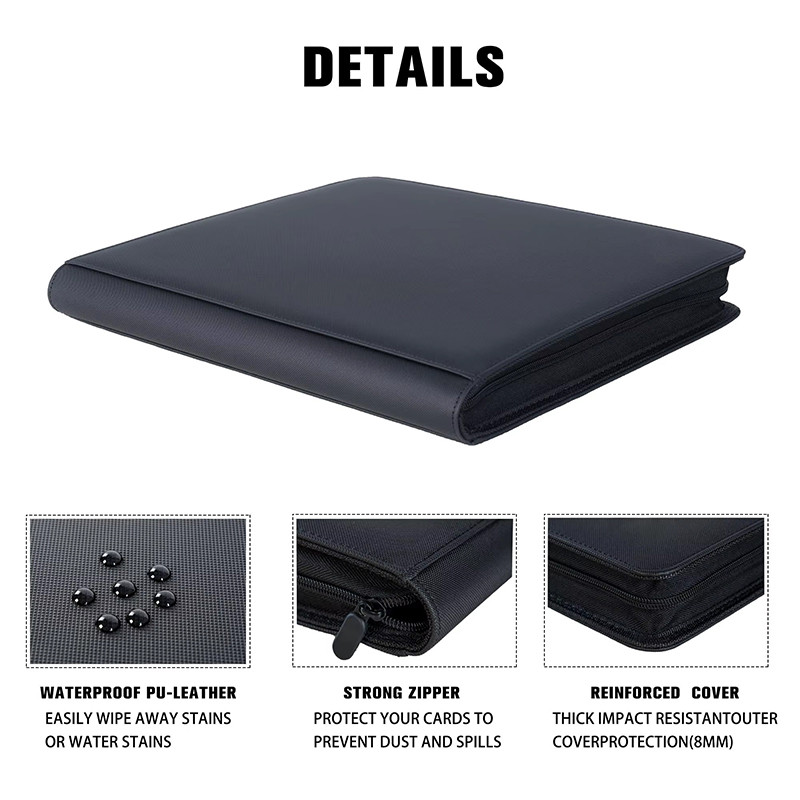
A leather-look 16-pocket binder has to be judged by hand: cover print, stitch line and page tension all decide whether the run is released.
Mistakes 4-6: Compliance, MOQ, and Inspection
Mistake 4: forgetting test certificates until the container is booked. Card accessories touch chemicals more than buyers expect: phthalates in soft PVC film, azo dyes in printed fabric, heavy metals in inks, nickel in metal snaps. Name the declarations you need, by shipping SKU, before tooling - REACH SVHC statements, phthalate-free film confirmation, CPSIA and Proposition 65 for the US, EN 71 where a product appeals to children in the EU. Resell under your own brand and you are the importer of record.
Mistake 5: under-ordering against MOQ break points. Breaks are not arbitrary; setup is fixed, so piece price steps down at 100, 500, 1,000 and 3,000 units. A buyer needing 480 units who orders 480 to save cash often pays more per unit than at 500 - and pays it again on every reorder. Compare landed cost at each band including freight and duty, and check whether assorted colours count toward one break.
Mistake 6: skipping pre-shipment inspection, or leaving AQL unstated. "We check every batch" is not a specification. AQL 2.5 for major and 4.0 for minor defects is the benchmark for general consumer goods, as Eurofins and QIMA describe, with zero tolerance for critical defects such as a sharp edge. Put levels, sample size and report format in the PO and require photos with defects classified. On moulded or welded goods, add functional checks: lid closure force, page weld pull, hinge cycles, zipper travel.

Deck boxes need functional inspection, not cosmetic only: convertibility, lid retention and card fit at full capacity drive the returns rate.
Mistakes 7-8: Carton Structure and Freight Weight
Mistake 7: assuming one carton is one SKU. Mixed cartons are normal here - 12 binders, 40 deck boxes, 200 sleeves in one master carton - and each SKU needs its own barcode panel, case pack count and scannable label. Chain retail usually asks for a GS1-128 label carrying the SSCC plus the retailer's case pack rules; distributor and marketplace channels are more forgiving. Specify board grade, inner polybag, divider and carton marking before production, because retrofitting labels after packing is the slowest fix available.
Mistake 8: ignoring packaging weight and carton dimensions in freight. Couriers and air carriers bill the greater of actual and volumetric weight, and the divisor matters: most express couriers use 5,000, air freight commonly uses 6,000, so the same carton can carry about 20% more chargeable weight on one channel. A printed colour box plus divider adds 60-120g and a few millimetres per axis, which compounds across a pallet. Calculate from packed carton dimensions and price air and sea before finalising the packaging format.

Rigid-card binders add weight and depth per unit, so a carton that worked for sleeved albums can cross a freight band when pages hold toploaders.
Mistakes 9-10: Spares and Revision Limits
Mistake 9: ordering exact quantities with no spares. Retail and marketplace channels generate damaged and lost units, and a display-ready case with a cracked lid cannot be sold. Order 1-2% spares on a first run and write a replacement clause covering breakage found on arrival. The alternative is reordering 30 units at a 100-unit MOQ, paying setup again, and waiting three weeks for stock that should already be on a shelf.
Mistake 10: no written revision limit. "We refine until you are happy" sounds generous and behaves as a schedule risk. State that two artwork rounds and one pre-production sample revision are included, then name the rate beyond that. Lock a version number on the dieline and packaging file, and require written sign-off at each gate: dieline, artwork proof, sample, pre-production sample. Buyers who skip the gates pay the time later, after the goods are made.

Acrylic is the least forgiving on spares: a chipped corner or scratched face cannot be reworked, only replaced, so budget replacements into the run.
Good vs Bad Order Briefs Compared
The difference between a smooth programme and a painful one is usually visible in the first email.
| Brief element | Weak brief | Strong brief | Cost of the gap |
|---|---|---|---|
| Artwork | RGB JPEG traced from a photo | CMYK PDF/X-4 on the factory dieline with Pantone refs | Reprint, 3-4 weeks lost |
| Sample | "Send your catalogue item" | Pre-production sample in final material, sealed as golden sample | No reference at inspection |
| Tooling | One unit price, no tooling line | Tooling itemised, ownership and buyout stated | Paying setup twice |
| Compliance | "Meets EU and US standards" | Named declarations listed by shipping SKU | Customs hold, relabelling |
| Quantity | "Best price for 480 pieces" | Costed ladder at 100, 500, 1,000, 3,000 pieces | Overpaying on every reorder |
| Inspection | None specified | AQL 2.5 major, 4.0 minor, critical zero, photo report | Chargebacks after arrival |
| Cartons | "Standard export carton" | Case pack, board grade, GS1-128 label, drop test | Crush claims, retailer fines |
| Freight | Estimate from unit weight | Chargeable weight from packed carton dimensions | 20-30% freight variance |
How to Avoid Custom Card Accessories Mistakes in Your First Brief
1. Request the dieline first. Get the vector dieline and material swatches before artwork starts; everything downstream depends on it.
2. Write the spec as a table. Construction, material and gram weight, dimensions, capacity claim, print method, colours, packaging, case pack, barcode, inspection level, spares.
3. Ask for a costed quantity ladder. Three or four bands, tooling shown separately, with a stated validity period. Price at the band you will reorder from.
4. Request the compliance file up front. Ask for declarations on a comparable existing SKU. A supplier who cannot produce a REACH statement today will not produce yours on schedule.
5. Approve colour on the substrate. Pantone reference plus Delta E tolerance, checked under retail lighting on the real material.
6. Name the inspection standard. AQL levels, sample size, functional tests, photo report format, and who pays for a failed inspection.
7. Book freight from packed dimensions. Get carton dimensions before the packaging format is final, then price air and sea on chargeable weight.
Best Practices for Repeat Orders
Keep the golden sample and inspect each repeat against it, not against the drawing. Record material, film gauge, Pantone references and dieline version in the PO so a reorder cannot drift when a factory changes a supplier. Hold the price ladder for six to twelve months and note what would move it - resin index, film cost, or a change in case pack.
Plan backwards from the retail window: sample, approval, production, sea freight, DC booking. Sea at 25-35 days plus two weeks of inland handling means production must finish about six weeks before the shelf date. Buyers who order against a sell-through trigger usually reconcile with air freight, which is the expensive way to be right. Consolidate SKUs too: two products from one factory share tooling setup, inspection and carton handling; two factories double all three.
Wholesale and Retail Notes for Buyers (MOQ, Packaging, Lead Time)
GUARD TCG has manufactured card protection since 2009, with output above 300 million pieces a year, 10,000+ customers and 500+ distributors across 70+ countries. For a first order that means MOQ from 100 pieces per style on stock constructions, tooling quoted separately for genuine custom work, packaging specified in the quotation rather than discovered later, and full-batch inspection before every shipment.
Packaging runs from polybag and printed header through colour box, belly band and hang-tag, with barcode and carton marking handled in the same order - no second MOQ, no freight leg between a printer and a packing house. Custom covers, branded pulls, printed sleeves and private-label ranges run through our OEM/ODM programme; stock references sit in the card binder and collector album range and the acrylic display case range.
Lead time is 5-12 days by DHL, FedEx or UPS for samples and small orders, and 25-35 days by sea for containers after sample approval. Send artwork status, target quantities and packaging requirements through the inquiry form; the useful first reply is a dieline plus a costed ladder, not a catalogue.
About GUARD TCG
GUARD TCG is a trading card protection manufacturer founded in 2009, producing 300 million+ pieces a year for 10,000+ customers and 500+ distributors in 70+ countries. The range covers sleeves, toploaders, rigid holders, slab accessories, binders, storage boxes and acrylic display cases, supplied through wholesale and OEM/ODM programmes with MOQ from 100 pieces. Every batch is inspected before shipment, and the team supports buyers with dieline development, colour management, private-label packaging and freight planning. See the product catalogue or the company profile.
FAQ
Q1. Which of these mistakes costs the most on a first order?
Tooling handled badly. A reprint or new die after approval is non-refundable and costs three to four weeks, and buyers who accept an all-in unit price without an itemised tooling line often pay setup again on the second order.
Q2. How much sample cost is normal for custom card accessories?
Expect a charged sample with a stated credit against bulk, and 7-12 days for a custom build. Free samples are usually stock items, useful for judging material and finish but not for validating your artwork or packaging.
Q3. What AQL should I put in the purchase order?
AQL 2.5 major and 4.0 minor is the common benchmark for general consumer goods, with zero tolerance for critical defects. Add functional checks - lid retention, weld pull, zipper travel - because a cosmetic pass can hide a product that will not work.
Q4. Should I order to the MOQ break point or to my real requirement?
Price both. If 480 pieces sits in a higher band than 500, the 500-piece order is often cheaper per unit and leaves safety stock. Compare landed cost including freight and duty, not unit price alone.
Q5. How do I stop a repeat order drifting from the approved product?
Seal a golden sample, record material and film references and the dieline version in the PO, and inspect each repeat against the sealed unit. A supplier who quietly changes film gauge breaks shelf consistency without telling you.
Conclusion
Ten mistakes, one root cause: the first order is treated as a purchase instead of a specification. Get a physical sample in hand, itemise tooling and its ownership, convert artwork to CMYK with Pantone references, request certificates by SKU, order to the quantity break that will hold on reorder, name your AQL levels, define cartons and labels, price freight on packed dimensions, include spares, and write the revision limit down. Do that and the first order becomes a template the second order can repeat. To compare constructions and materials before you brief, browse the full catalogue or send dimensions and volumes through the inquiry page.