Card Sleeves Supplier Guide: How Importers Vet a Manufacturer in 2026
- Share
- publisher
- GUARD TCG Team
- Issue Time
- Oct 28,2026
Summary
How importers vet a card sleeves supplier in 2026: the four documents to request before ordering, MOQ vs tooling, factory audit vs AQL inspection, trading company vs factory, and realistic first-container lead times.
Card Sleeves Supplier Guide: How Importers Vet a Manufacturer in 2026
For importers, distributors and retailers sourcing card sleeves, the difference between a great supplier and a costly one comes down to four things you verify in writing before any order: a material declaration naming polypropylene (PP) and confirming non-PVC, the thickness tolerance in microns, a factory audit or AQL inspection result, and the reorder lead time. Ask for a sample run before the bulk order, confirm MOQ and tooling separately, and check export documentation such as the HS code and test reports. A card sleeves supplier that answers all four in a written quote is usually the one that scales with your business.
What Buyers Actually Mean by Card Sleeves Supplier
"Card sleeves supplier" is a broad term that buyers use to mean three different layers, and knowing which one you are talking to changes everything about the quote you receive. A film supplier sells rolls of polypropylene or polyester film, the raw material, but does not convert it into finished sleeves. A manufacturer, also called a converter, takes that film, cuts and seals it into sleeve shapes, and applies printing, custom sizing, and packaging — this is the partner you want for a long-term card sleeves supplier relationship. A trading company sits in between, buying finished sleeves from a factory and reselling them with a markup and, ideally, added service such as consolidation and quality control.
For importers, the practical rule is to establish which layer you are dealing with on the first call. If you plan custom sizes, custom print, or a private-label line, you need a manufacturer or an OEM/ODM factory, not a film supplier. If you are only topping up an existing SKU in standard sizes such as 66 mm x 91 mm for Pokémon or Magic: The Gathering cards, a trading company can still work, but you will pay for the convenience. Spell out in the RFQ whether you want finished sleeves, custom tooling, or just stock.
Why Vetting Beats Price Shopping
Price shopping alone is how importers end up with a container of sleeves that cloud, stick, or split at the seam. A card sleeve sits directly against a collectible's surface for years, so a supplier's material choices become your product-quality problem the moment a customer files a return. The stakes are structural: the trading card market is widely estimated at roughly $15 billion in 2026 by research firms such as Mordor Intelligence, and The Pokémon Company reports more than 85 billion cards printed cumulatively, which makes sleeve demand a durable, high-volume category rather than a fad.
Vetting beats price shopping because the cost of a bad batch is hidden in the reorder. A sleeve that yellows or releases residue damages the cards inside, and the buyer — not the factory — owns that reputation risk in their market. A written material declaration, a micron tolerance, and an inspection record cost nothing to request but immediately filter out suppliers who cannot document what they make. In practice, a supplier that hesitates to name the film or the thickness is quoting you a price on an unknown product.
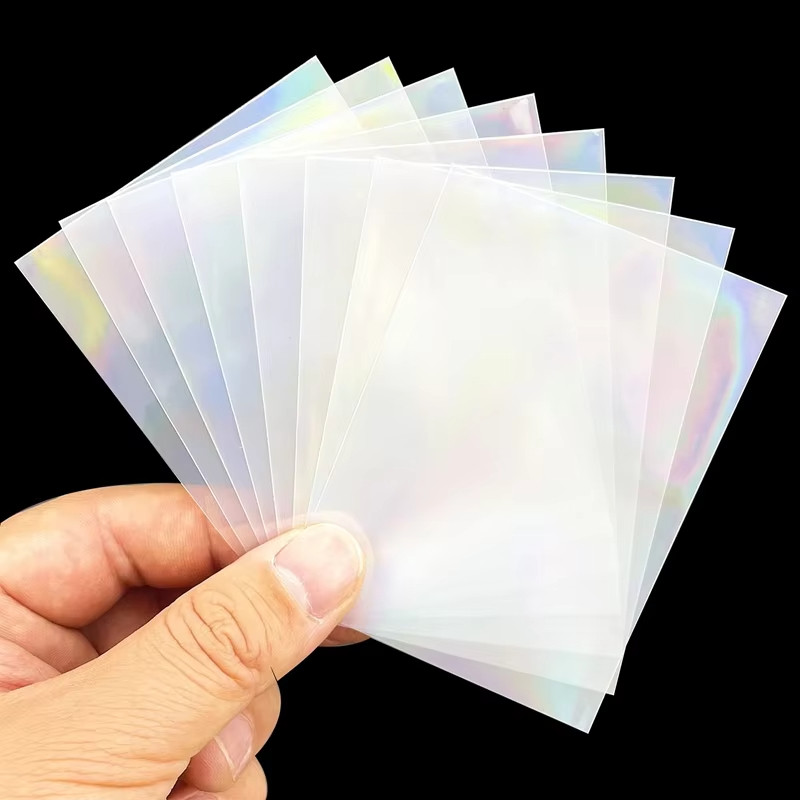
Retail-ready PP sleeves like these holographic polypropylene sleeves are a PVC-free line that stores can sell with confidence — exactly the kind of documented material you should expect from a vetted card sleeves supplier.

Four Documents to Request Before Any Order
Before you wire a deposit, ask the card sleeves supplier for four things in writing. First, a material declaration that names the polymer — polypropylene (PP) — and explicitly states non-PVC and acid-free. Second, the thickness tolerance in microns; penny sleeves commonly run around 40 to 45 microns, standard and inner sleeves around 50 microns, and premium or art sleeves from 90 to 120 microns, and the tolerance tells you how much that figure can drift between runs. Third, a factory audit or AQL (Acceptable Quality Limit) inspection result from a recent production run. Fourth, a written reorder lead time, not a sales-call estimate.
On top of those four, confirm the export documentation: the HS code for finished plastic card sleeves (typically under chapter 3923, for example 3923.21, rather than 9504, which covers games and consoles), and any test reports for heavy metals or phthalates if your market requires them, such as the EU or certain US states. A supplier that answers all four points in the quote, in writing, is demonstrating the process maturity you are actually paying for.
MOQ, Tooling, and Sample Runs Explained
MOQ and tooling are two separate line items that inexperienced importers often merge. MOQ is the minimum order quantity for a production run; at GUARD TCG custom programs generally start at 100 pieces. Tooling is the upfront cost of creating a custom die, size, or print plate when your sleeve is not a standard stock item. Ask for each figure separately so a "low MOQ" quote does not hide a tooling charge that appears later.
Sample runs are the cheapest insurance in the whole sourcing process. A pre-production sample lets you check clarity, seam strength, fit on the actual card, and how the printed art looks under retail lighting before the factory commits the full run. Some suppliers charge for samples and credit the amount against the bulk order; clarify that on the quote. For a custom Chinese card sleeves supplier relationship, the sample step is also where you lock the exact dimensions, film, and finish that will define every reorder for years.
Custom printed PP art sleeves show what a manufacturer can do with your own designs — a capability worth confirming with a sample run before you commit to tooling.

Factory Audit vs AQL Inspection Compared
Two verification tools come up constantly in card sleeves sourcing, and they are not the same thing. A factory audit evaluates the facility itself; an AQL inspection evaluates a specific finished batch.
| Dimension | Factory Audit | AQL Inspection |
|---|---|---|
| Purpose | Assess capability, systems, compliance | Judge whether a batch meets spec |
| When | Before or at the start of a relationship | At the end of each production run |
| Performed by | Third-party auditor or your QC team | QC inspector on a sampled batch |
| What it checks | Equipment, materials, labor, certifications, capacity | Seam strength, clarity, dimensions, print, packaging |
| Sampling | Facility-wide, not product-specific | Statistical sample per AQL level |
| Output | Audit report and corrective actions | Pass/fail against agreed AQL |
| Best use | Shortlisting a new supplier | Approving each shipment before it leaves |
Use the audit to choose the supplier and the AQL to approve the goods. Most professional importers run both: an audit once, then an AQL inspection on every order.
How to Choose Between Trading Company and Factory
A factory gives you lower unit cost, direct communication on material and tooling, and the ability to customize, but it usually expects larger volumes and more of your time on specs and quality control. A trading company adds a margin but can consolidate smaller orders, handle multiple product categories, and manage communication in your language, which is valuable for buyers placing mixed SKU orders across sleeves, toploaders, and storage boxes.
The decision is about volume and product mix. If card sleeves are a core, high-volume line you will reorder for years, go to the factory and invest in the audit. If you are a retailer or distributor testing the category or bundling accessories, a trading company can smooth the first few containers. Many established buyers use a hybrid: a factory for the flagship sleeve SKUs and a trading company for adjacent accessories.
Sample Order to First Container: A Timeline
Here is how a well-run first order moves, so you can plan your cash and your shelf dates. Week one to two: send specs, receive the quote with the four documents, and order samples. Week two to three: review the pre-production sample, approve dimensions and print, and pay the deposit. Weeks three to six: production runs, followed by in-house full batch inspection. Then shipping: express air freight via DHL, FedEx, or UPS typically takes 5 to 12 days, while sea freight runs 25 to 35 days for larger orders.
Add customs clearance and inland delivery on top, and a first container from a Chinese card sleeves supplier realistically lands in six to ten weeks door to door depending on your route and destination. Locking the reorder lead time in writing matters here, because your second order should be faster once tooling and specs are already approved.
Soft clear inner sleeves are the safe first layer that doubles as a chemical barrier inside toploaders, and the kind of consistent SKU that makes repeat bulk orders predictable.

Best Practices and Common Mistakes for Repeat Bulk Orders
Best practices: re-confirm the material declaration on every purchase order, not just the first one, so a factory cannot silently substitute film. Keep the approved sample as the gold reference and cite it in the PO. Schedule AQL inspection on every batch, and keep the inspection record for warranty and reorder disputes.
Common mistakes include trusting a price quote without a material or thickness spec, assuming a thicker sleeve is automatically safer (thickness is about handling, not chemical safety), skipping the sample because you are in a hurry, and not confirming the HS code and test reports before the container ships, which can stall customs and eat your margin. The importers who scale treat each reorder with the same discipline as the first.
Wholesale and Retail Notes for Buyers (MOQ, Packaging, Lead Time)
For distributors and retailers, the buying decision is also a merchandising and margin decision. MOQ at GUARD TCG for custom programs starts at 100 pieces, which keeps a first private-label test affordable. Packaging options range from retail polybags with hang holes for shelf display to bulk cartons for fulfillment and club stores; printed insert cards and custom branding are available through our OEM/ODM program. Lead time splits by shipping: express air freight via DHL, FedEx, or UPS runs 5 to 12 days, and sea freight 25 to 35 days for cost-sensitive volume.
Stock a tiered sleeve lineup rather than one SKU: penny sleeves for bulk storage, 50-micron standard and inner sleeves for everyday play, and 90-to-120-micron premium and art sleeves for collectors and high-value cards. That tiering mirrors how your customers actually buy and protects margin across the range. Explore our OEM/ODM services to build a private-label sleeve line, or browse the card sleeves category for ready-to-stock styles.
Sealable perfect-fit inner sleeves round out a tiered lineup for collectors and high-value cards, giving retailers a premium tier beyond penny and standard sleeves.

About GUARD TCG
GUARD TCG is a trading card and collectibles accessories manufacturer established in 2009, producing more than 300 million units a year for over 10,000 customers in 70-plus countries, including more than 500 distributors. Our range covers card sleeves, toploaders, rigid protectors, graded card storage boxes and slab cases, acrylic display cases, binders and storage solutions, with OEM and ODM programs for custom dimensions, colors, print and branding. Every order runs through full batch inspection before dispatch, we support express air freight (DHL, FedEx, UPS, typically 5 to 12 days) and sea freight (25 to 35 days), and custom programs generally start at an MOQ of 100 pieces. Learn more on our about page.
FAQ: Card Sleeves Supplier Vetting
Q1: What is a reasonable MOQ for custom card sleeves?
Custom card sleeve programs at GUARD TCG generally start at 100 pieces, with tooling quoted separately for custom sizes and print. Clarify MOQ and tooling as two line items on your quote.
Q2: Which HS code should card sleeves be imported under?
Finished plastic card sleeves are typically classified under chapter 3923 (for example 3923.21), not 9504, which covers games and consoles. Confirm the exact code and any test reports with your supplier and customs broker.
Q3: How do I confirm a sleeve is PVC-free?
Ask for a written material declaration naming polypropylene (PP) and stating non-PVC and acid-free, and check for a strong plastic smell or clingy feel in samples, which can indicate soft PVC.
Q4: Should I run an inspection on every order?
Yes. Use a factory audit to shortlist a supplier once, then an AQL inspection on every production run before the goods leave, and keep the records for reorders and disputes.
Q5: How long does a first container take?
A first order typically runs six to ten weeks door to door: samples and deposit in the first weeks, production and inspection in the middle, then express air freight (5 to 12 days) or sea freight (25 to 35 days) plus customs clearance.
Conclusion
Vetting a card sleeves supplier is a written process, not a hunch. Verify the four things that matter — material declaration (PP, non-PVC), thickness tolerance in microns, a factory audit or AQL inspection result, and reorder lead time — then lock MOQ and tooling separately and approve a sample before the bulk run. Suppliers that document these answers are the ones that scale, and your repeat orders will be faster and more consistent once the specs are on file. Review our full product range for PVC-free sleeve lines, or send your sizes and volumes through the inquiry form for a matched quote on the card sleeves supplier your market needs.