Licensing Reality: Can You Make Your Own Pokémon-Style Display Cases?
- Share
- publisher
- GUARD TCG Team
- Issue Time
- Sep 14,2026
Summary
Pokemon display case OEM and licensing explained: you cannot sell cases bearing Pokemon trademarks, logos, or artwork without a licence from The Pokemon Company International, but you can make generic unbranded cases that fit standard ETBs, tins, and booster boxes. This guide covers licensed vs unlicensed card accessories, the trademark/copyright/design line, seller risks, and compliant OEM practices.
Licensing Reality: Can You Make Your Own Pokémon-Style Display Cases?
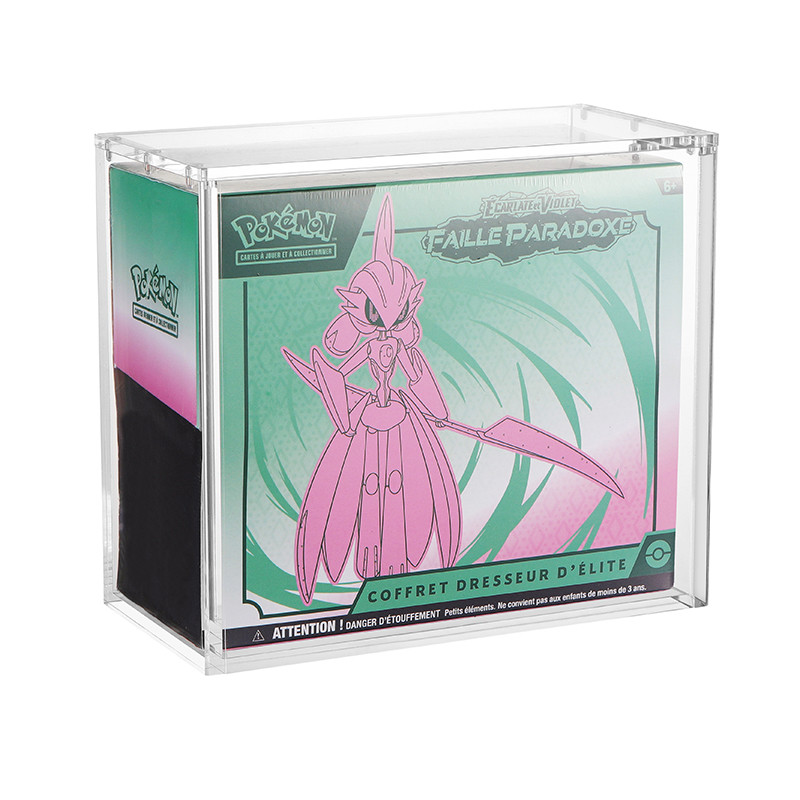
Short answer: you cannot legally manufacture or sell display cases that carry Pokémon trademarks, logos, character artwork, or distinctive trade dress without a licence from The Pokémon Company International (TPCi). What you can do is make generic, unbranded protective cases that are sized to fit Pokémon Elite Trainer Boxes, tins, and booster boxes — provided the product itself carries no Pokémon marks and claims no official endorsement. That “fits, but bears no marks” line is where most legitimate aftermarket accessory brands operate.
This guide sets out that boundary: what licensed and unlicensed really mean in card accessories, which rights actually protect a Pokémon product, the practical risks of crossing the line, and how to build a compliant display-case program. If you want to see the kind of unbranded, OEM-ready acrylic cases we produce, start with the card accessories catalog and match it to the sealed products you plan to protect.
What Does “Licensed” vs. “Unlicensed” Actually Mean in TCG Accessories?
“Licensed” means the brand owner has granted a manufacturer the contractual right to use its intellectual property on commercial goods. For Pokémon, that brand owner is The Pokémon Company International, acting on behalf of Nintendo, Creatures Inc., and GAME FREAK inc. A licence spells out which characters and logos you may use, in which product categories and territories, for how long, and at what royalty rate — and it usually requires the brand owner to approve designs and packaging before they ship.
“Unlicensed” is not the same as “illegal.” A clear acrylic box cut to hold a 3.5-inch-wide Elite Trainer Box uses no Pokémon artwork, no logo, and no character name, so no third-party trademark is being used on the goods. It is a functional protective article. The legal problem only begins when a manufacturer prints Pikachu, the Poké Ball symbol, a character name, or the word “Pokémon” onto the product, its packaging, or its marketplace listing.

A generic acrylic ETB display case protects the sealed product without reproducing any brand owner's marks — the key distinction between an unlicensed accessory and an infringing one.
Trademark, Copyright, and Design: What Actually Protects a Pokémon Product?
Four different rights can be in play, and they are not interchangeable. Understanding which one applies tells you exactly what you must avoid.
- Trademarks protect brand identifiers — the word “Pokémon,” the Poké Ball symbol, character names, and logos. Applying them to goods you sell without authorisation is the clearest form of infringement.
- Copyright protects original artwork — character illustrations, card art, and packaging design. Printing a copyrighted illustration onto a sleeve or case infringes even if you never type the word Pokémon.
- Design rights and trade dress can protect a distinctive product shape or overall look. A case that mimics an official product so closely it confuses buyers may be actionable even with no logo present.
- Patents occasionally cover a mechanism — a hinge, a magnetic latch, a dispenser gate — but never the general idea of “a box that holds cards.”
The practical upshot for accessory makers is straightforward: keep the product, its packaging, and its marketing free of anyone else's marks and artwork, and describe compatibility factually rather than implying endorsement.
Why the Licensing Line Matters: Real Risks for Sellers
- Marketplace takedowns. eBay's VeRO programme, Amazon's Intellectual Property Policy, and Etsy's reporting system let brand owners remove infringing listings quickly — often damaging the seller account at the same time.
- Customs seizures. Infringing or counterfeit goods can be detained at the border where a rights holder has recorded its marks with customs authorities.
- Civil claims. Rights holders can seek injunctions and damages; in the United States, statutory damages for counterfeiting can escalate sharply per mark in serious cases.
- Retail and distributor fallout. A licence conflict can end a relationship with a large account that will not stock grey-market branded goods.
- Reputation cost. Once a brand is flagged as an infringer, marketplace reinstatement and supplier trust both get harder to rebuild.
None of this is legal advice, and every case turns on its own facts — but the pattern is consistent: the money saved by skipping a licence is small next to the cost of a takedown, a seizure, or a lawsuit.

An unbranded booster-pack dispenser serves retailers without borrowing a game's name or characters — functional display, not branded merchandise.
Licensed vs. Unlicensed Card Accessories: Side-by-Side Comparison
The table below summarises where the two models sit on the measures that affect cost, legal exposure, and design freedom.
| Factor | Licensed Merchandise | Unlicensed Compatible Accessory |
|---|---|---|
| Brand marks allowed | Yes — within the scope of the licence | None — marks must be absent |
| Approval process | Licence agreement plus design and packaging approvals | No third-party approval; you self-certify compliance |
| Cost structure | Upfront fees and ongoing royalties | No royalty — standard manufacturing cost only |
| Legal exposure | Low, provided you stay inside the licence | Low if you avoid marks and artwork; high if you use them |
| Marketplace risk | Protected as authorised merchandise | Listings removed if perceived as infringing |
| Design freedom | Constrained by brand guidelines | Full freedom within a generic form factor |
| Typical products | Branded sleeves, tins, figures, official playmats | Plain cases, generic sleeves, slabs, storage boxes |
| Best for | Established firms able to meet licence terms | OEM/ODM and private-label accessory makers |
How to Tell Whether a Pokémon Product Is Officially Licensed
For buyers and retailers, the same signals work in reverse — they tell you whether a product is officially authorised or an aftermarket accessory.
- Brand marks on the goods and packaging. Genuine licensed merchandise carries the official logo and legal notices; compatible accessories deliberately do not.
- Legal and copyright lines. Licensed products name the rights holders and often display a copyright year and licence notice.
- Official brand styling. Licensed goods follow the current brand guide; generic cases look plain by comparison.
- Where it is sold. Licensed merchandise flows through authorised distributors and major retail; compatible accessories are typically sold by third-party accessory brands.
- Wording in the listing. “Officially licensed” versus “compatible with” and “fits” is the fast tell.
If a maker claims “official” without a licence, that is the red flag — and it is exactly the claim a rights holder will act on.
How to Sell Compatible Display Cases Without Infringing
This is the zone where legitimate aftermarket brands live, and the rules are simple to state and worth following precisely.
- No third-party marks on product or packaging. No logos, no character names, no official artwork.
- Describe compatibility descriptively. “Fits a standard Elite Trainer Box” is factual; a listing titled with a game's brand as if endorsed is not.
- Avoid copied artwork and colour schemes. Do not reproduce illustrations, patterns, or official look-and-feel.
- Never imply endorsement. Skip words such as “official,” “licensed,” and “authorised” unless you actually hold that status.
- Do not copy trade dress. Keep your case visually distinct from the official one, not a near-replica.
- Keep your own brand front and centre. Your logo and product name should be the most prominent identifiers.
This mirrors the long-standing principle — discussed in US case law under the name “nominative fair use” — that you may refer to another brand to describe what your product fits, but you may not use that brand to suggest a relationship that does not exist. The same reasoning is why third-party phone-case makers can say a case “fits” a model without being a licensee.

A clean, high-transparency case does the protective job on its own merits — no borrowed artwork required.
How to Pursue an Official Pokémon Licensing Deal
If you want to sell genuinely branded merchandise, the route is a formal licensing application, not a guess. The Pokémon Company International operates a licensing program, and it is approached like any serious commercial partnership.
- Prepare a company profile. Legal entity, ownership, years in operation, and audited or credible turnover.
- Show manufacturing capability. Your factory, your QC process, and proof you can hit consistent quality at volume.
- Present a product concept. Category, materials, price positioning, and how it fits the brand's own strategy — without using their artwork yet.
- Map your distribution. Retail channels, territories, and sell-through evidence for comparable products.
- Accept the terms. Royalties, minimum guarantees, territorial limits, and mandatory approval stages come with the licence.
- Be patient. Licensing timelines are long, and most first-time applicants are declined.
The honest framing for a factory is this: a licence suits companies with proven distribution and the resources to meet minimum guarantees. For everyone else, the compliant generic-accessory path is both faster and lower-risk.
Best Practices for a Compliant OEM Program
- Write a no-marks rule into your product brief. Make it explicit for designers and printers, in writing.
- Audit your listings quarterly. Marketplace titles and images drift; catch stray keywords early.
- Train sales staff on the “fits” script. Consistency in how compatibility is described prevents careless claims.
- Keep design files and approvals on record. Documentation is your defence if a claim ever arrives.
- Refuse custom orders that cross the line. A customer asking for Pikachu on a case is asking you to carry their legal risk.
- Consult an IP lawyer for high-stakes launches. A short review is cheap insurance before a big production run.

Grade-agnostic slab holders are a textbook compatible accessory: they fit standard slabs without naming or imitating any grading company's brand.
About GUARD TCG
GUARD TCG is a trading card accessories factory established in 2009, producing more than 300 million pieces a year for customers in over 70 countries. We work with more than 10,000 customers and 500+ distributors, and we offer both OEM and ODM programs alongside our standard catalog. Standard items start from an MOQ of 100 pieces, custom projects are quoted individually, and every batch is inspected before it leaves the line. Our acrylic display cases, booster-pack dispensers, and slab holders are all supplied as unbranded or private-label goods — we do not reproduce third-party trademarks, logos, or artwork on any product, and we are glad to sign a written compliance commitment on request. We ship by DHL, FedEx, and UPS (5–12 days) or by sea (25–35 days). You can read more on our about page or send specifications to our team via the inquiry form.
FAQ
Is it legal to sell a display case that fits an Elite Trainer Box?
Yes, generally — provided the case itself carries no Pokémon trademarks, logos, or artwork, and your listing does not claim it is official or licensed. You are selling a generic protective box, not Pokémon merchandise. This is general information, not legal advice; check with a qualified IP attorney for your specific product.
Can I put a Poké Ball or Pikachu on my case if I am not a licensee?
No. Those are protected marks and copyright-protected artwork. Applying them to goods you sell without authorisation is precisely the conduct that gets listings removed and goods seized.
Do I need a licence to make a plain acrylic box for a friend's collection?
A one-off personal project with no marks and no sale is a different situation from commercial manufacturing and selling. The regulated activity is commercial use of the brand owner's marks and artwork; keeping the product generic and unbranded keeps you well clear of it.
How do I approach The Pokémon Company for a licence?
Submit a proper business case through its licensing programme: company profile, manufacturing capability, product concept, and distribution plan. Expect an application process, royalties, minimum guarantees, and design-approval stages if accepted.
What can go wrong if I skip the rules?
Marketplace removal under policies such as eBay's VeRO or Amazon's IP Policy, customs detention of shipments, injunctions and damages in civil suits, and lasting damage to your brand and supplier relationships. The savings from cutting corners are far smaller than the downside.
Conclusion
You cannot legally make Pokémon-branded display cases without a licence from The Pokémon Company International — but you can absolutely manufacture and sell generic, unbranded cases that fit Pokémon-style sealed products, as long as no third-party marks or artwork appear anywhere on the goods, the packaging, or the listing. The deciding factor is never the shape of the box; it is whether you used someone else's trademark, copyright, or trade dress. Keep your products plain and your claims factual, describe compatibility with “fits” rather than “official,” and a compliant OEM display-case programme is open to you. Cross the line into marks and artwork, and the takedowns, seizures, and lawsuits follow. Build on the safe side of that boundary and the opportunity is real.