PP vs PET vs PVC Card Sleeves: Material Science Explained
- Share
- publisher
- GUARD TCG Team
- Issue Time
- Oct 27,2026
Summary
How PP, PET, and PVC card sleeves differ in clarity, flexibility, and long-term stability, and why PVC-free polypropylene and polyester are the archival-safe choices for buyers.
PP vs PET vs PVC Card Sleeves: Material Science Explained
PP, PET, and PVC card sleeves differ in clarity, flexibility, thickness, and long-term stability. Polypropylene (PP) is soft, inexpensive, and ideal for inner penny sleeves; PET is stiffer and clearer for rigid outer protection; PVC is soft and clear but can degrade and release plasticizers. Choosing the right polymer depends on whether the sleeve touches the card long-term. For importers, retailers and distributors, this guide maps the material science to the buying decision, so you stock PVC-free SKUs that protect collector value and sell at the right tier.
What PP, PET, and PVC Actually Are
The three most common sleeve polymers are polypropylene (PP), polyethylene terephthalate (PET, sold under names such as Mylar and Melinex), and polyvinyl chloride (PVC). PP is a flexible polyolefin that stays pliable without chemical additives, which is why it dominates penny sleeves and inner sleeves. PET is a polyester film prized by conservators for dimensional stability and optical clarity. PVC is a vinyl polymer that, in its soft form, requires plasticizers to stay supple. Understanding this distinction is the whole game for card safety: PP and PET are inert as molded, while soft PVC carries additives that move over time.
In the trading card world, these materials show up in different jobs. PP is the workhorse for inner sleeves, outer matte sleeves, and printed art sleeves. PET appears in semi-rigid card savers, premium clear sleeves, and some rigid holders. PVC historically appeared in cheap "crystal clear" sleeves and older vinyl pages. A sourcing decision between them is really a decision about contact time, clarity, and price point.
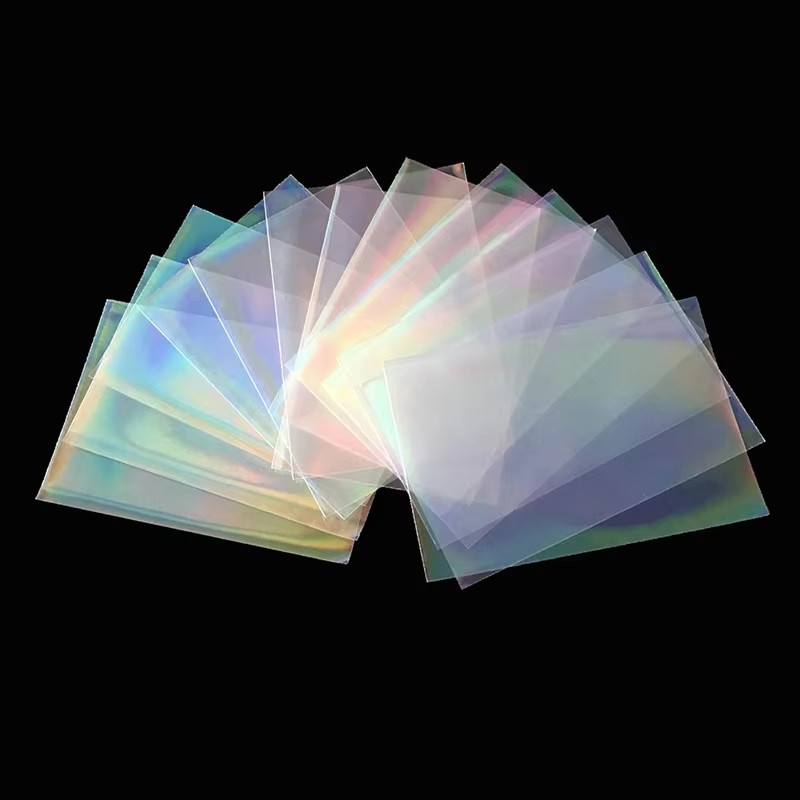
Retail-ready PP card sleeves like these holographic polypropylene sleeves give stores a PVC-free line that protects cards while still showing off artwork clearly.

Why Polymer Chemistry Changes Long-Term Card Safety
Card sleeves do more than block scratches; they sit directly against the card surface for years. Any additive in the film that migrates, clouds, or turns acidic will eventually reach the ink and coating. Soft PVC needs plasticizers, often phthalates or similar compounds, to stay flexible, and those plasticizers gradually migrate outward as an oily, tacky residue. As PVC degrades it can also off-gas acidic byproducts, and its breakdown accelerates with heat, roughly doubling in rate with each significant temperature step.
PP and PET are the opposite: both are chemically inert in normal storage and contain no plasticizers, so they do not release residue onto the card. This is why archival standards for photographs and documents lean on polyester film, and why card conservators treat polypropylene as the everyday minimum. When you buy for resale or long-term display, the chemistry of the film is a product-quality feature, not a footnote.
PP vs. PET vs. PVC Sleeves Compared
The table below summarizes how the three polymers behave in the real world, from clarity and feel to what happens after five years in a drawer or on a shelf.
| Property | PP (Polypropylene) | PET (Polyester) | PVC (Polyvinyl Chloride) |
|---|---|---|---|
| Clarity | Very good, crisp | Excellent, highest optical clarity | High at first, then clouds |
| Flexibility | Soft and pliable | Stiffer, more rigid | Very soft, clingy |
| Plasticizers | None | None | Yes, in soft PVC |
| Archival safety | Safe | Gold standard | Not archival-safe |
| Aging over time | Stays clear | Stays crystal clear | Yellows, off-gasses |
| Cost | Low to mid | Highest | Lowest |
| Best use case | Inner and everyday sleeves | Premium and archival sleeves | Short-term only, avoid |
The takeaway is consistent with what reputable brands such as Ultra PRO and Dragon Shield publish on their packaging: PVC-free, acid-free polypropylene is the standard, and polyester is the preservation upgrade. "Crystal clear" printed alone is not a material claim and should not be read as one.
How to Choose a Material by Use Case
Match the polymer to the job rather than to the price tag. For inner sleeves and penny sleeves, cast polypropylene (CPP) is the right call: it is thin, pliable, and safe as a first layer against the card. For outer sleeves that will be handled, shuffled lightly, or displayed, PP again offers the best balance of cost, clarity, and safety. For high-value singles, grading submissions, and museum-style storage, PET or a PP inner inside a PET card saver is the preferred stack.
Reserve PVC only for non-archival, short-term uses where you are certain the card will not stay in the sleeve, and even then it is rarely worth the risk. If a sleeve has a strong "new plastic" or shower-curtain smell, feels clingy, or is suspiciously cheap with no material listed on the pack, treat it as likely PVC and keep it away from anything you plan to keep. A practical layered approach is card into PP penny sleeve, then into a rigid holder, so the PP acts as a chemical barrier against any residual vinyl in an older toploader.
Custom printed PP art sleeves are the everyday outer-sleeve choice: PVC-free, pliable, and available in custom sizing for TCG lines.

Clarity, Stiffness, and Aging Over Time
Clarity is where the three polymers diverge over time. PET starts with the highest optical clarity and essentially never yellows or clouds, which is why it is the choice for slab-adjacent and premium clear products. PP is very clear on day one and stays clear in normal indoor storage, though it can pick up light scuffing faster than PET. PVC is the trap: it looks great out of the pack, then gradually clouds and yellows as plasticizers migrate and the polymer degrades.
Stiffness follows the opposite pattern. PVC and PP are soft and easy to double-sleeve, while PET is noticeably stiffer, which protects against bending but makes it feel less "grippy" in a deck. Thickness is also a factor: PP sleeves commonly run from roughly 40 to 120 microns depending on the grade, with penny sleeves around 45 microns and premium sleeves around 50 to 100 microns, whereas PET tends to be thinner gauge but much stronger for its thickness. Aging behavior is the deciding factor for anything stored more than a year or two.
Clear pull-tab polypropylene sleeves balance clarity and handling for both collectors and store shelves, staying clear through years of normal storage.

Storage and Handling Best Practices by Material
Store PP and PET sleeves cool, dry, and out of direct sunlight; neither needs special handling beyond avoiding heat that can warp the film. For PET, watch static, which can attract dust, and handle the edges rather than the face. For PVC, the best practice is simple: do not use it for anything you intend to keep, and never stack PVC sleeves against cards in a hot or enclosed space where off-gassing has nowhere to go.
Common mistakes to avoid include trusting a sleeve labeled only "non-toxic" (safe for people, not for cards), leaving soft PVC pages in an attic or car, and assuming a thicker sleeve is automatically archival. Thickness is about handling, not chemical safety. When in doubt, buy a film you can name, and confirm "PVC-free" and "acid-free" on the packaging.
Soft inner sleeves in clear polypropylene provide the safe first layer that doubles as a chemical barrier inside toploaders and outer sleeves.

Wholesale and Retail Notes for Buyers (MOQ, Packaging, Lead Time)
For importers, distributors and retailers, the material question is also a stocking and margin question. PVC-free polypropylene sleeves are the volume SKU: they move fast, suit inner and outer sleeve lines, and are inexpensive to spec in bulk. PET sleeves are the premium tier for collectors, grading workflows, and high-value card storage, and they justify a higher retail price point because of their archival positioning. Most custom card sleeve programs start around 100 pieces for our OEM and ODM services, with packaging options from retail polybags to bulk cartons and full custom print and branding.
Lead time depends on whether you take standard constructions or custom dimensions, colors, and print. Express air freight via DHL, FedEx, or UPS typically runs 5 to 12 days, and sea freight 25 to 35 days for larger orders. Ask your supplier to confirm the film material on every spec sheet, not just the marketing copy, so you can honestly label your shelf stock as PVC-free and archival-safe. Explore our OEM/ODM services for custom sleeve programs, or browse the card sleeves category for ready-to-stock lines.
About GUARD TCG
GUARD TCG is a trading card and collectibles accessories manufacturer established in 2009, producing more than 300 million units a year for over 10,000 customers in 70-plus countries, including more than 500 distributors. Our range covers card sleeves, toploaders, rigid protectors, graded card storage boxes and slab cases, acrylic display cases, binders and storage solutions, with OEM and ODM programs for custom dimensions, colors, print and branding. Every order runs through full batch inspection before dispatch, we support express air freight (DHL, FedEx, UPS, typically 5 to 12 days) and sea freight (25 to 35 days), and custom programs generally start at an MOQ of 100 pieces. Learn more on our about page.
FAQ: PP vs. PET vs. PVC Card Sleeves
Q1: Which card sleeve material is safest for long-term storage?
Polyester (PET) is the archival gold standard because it is chemically inert, contains no plasticizers, and never yellows or clouds. Polypropylene is a safe everyday minimum, while soft PVC is not archival-safe and should be avoided for anything you plan to keep.
Q2: How can I tell if a sleeve is PVC?
Look for a strong "new plastic" or shower-curtain smell, a clingy or tacky feel, and packaging that only says "crystal clear" or "non-toxic" without naming the film. If the material is not specified, treat it as suspect and keep it away from long-term storage.
Q3: Is a thicker sleeve automatically more protective?
No. Thickness improves handling and stiffness but says nothing about chemical safety. A thick soft-PVC sleeve can still release plasticizers, while a thinner PET sleeve is chemically stable and archival-safe.
Q4: Should I use an inner sleeve under a toploader?
Yes. A polypropylene penny sleeve between the card and a rigid holder acts as a chemical barrier, protecting the card from any residual vinyl or rough inner surface in an older toploader while also preventing surface scratches.
Q5: Why are PET sleeves more expensive than PP sleeves?
PET film costs more to produce and delivers higher optical clarity, greater rigidity for its thickness, and long-term archival stability. The premium reflects a preservation-grade material rather than just a marketing label.
Conclusion
PP vs PET vs PVC card sleeves is a material-science decision dressed as a packaging choice. PP is the safe, affordable everyday workhorse; PET is the preservation-grade upgrade for high-value and long-term storage; and PVC is a short-term material whose plasticizers make it a liability the moment a card stays inside. For buyers, the practical rule is to spec films you can name, confirm PVC-free and acid-free on the sheet, and match the polymer to the contact time. Review our full product range for PVC-free sleeve lines, or send your formats through the inquiry form for a matched quote on the card sleeves your market needs.