Pokemon SPC and Half Booster Boxes: Acrylic Case Sizing Guide
- Share
- publisher
- GUARD TCG Team
- Issue Time
- Oct 6,2026
Summary
Pokemon SPC acrylic case sizing explained for importers, distributors and retailers. SPC and half booster boxes are shorter and flatter than a full booster box, so a standard case leaves them rattling or cracks at the corners. Learn how to map box formats to internal cavity dimensions, set 1.5-3 mm clearance, control lid depth, and plan MOQ, packaging and lead time before ordering.
Pokemon SPC and Half Booster Boxes: Acrylic Case Sizing Guide
Pokemon SPC and half booster boxes are shorter and narrower than a full booster box, so a standard case leaves them rattling or, worse, cracks at the acrylic corners. A sizing guide that maps each SPC and half booster box format to its internal cavity dimensions prevents that. Matching internal cavity to box footprint is the single most important step before ordering. For retailers, importers and distributors stocking sealed Pokemon product, correct sizing also protects margin: a case that fits is a case that ships, displays and sells without returns.
What Makes SPC and Half Booster Boxes Different
A standard English booster box is built around a 36-pack brick, which gives it a tall, relatively deep footprint. The Pokemon SPC (Super Premium Collection) box breaks that pattern. It is long and flat, laid out horizontally to hold promo cards, boosters and accessories side by side, so its height is low while its length is close to a full booster box. A half booster box, sold mainly in UK and EU markets, is the opposite problem: it holds 18 packs and is small in every dimension.
That divergence matters because acrylic cases are tooled, not stretched. An acrylic shell is cut to a fixed internal cavity, so a case made for a 36-pack box will not gently adapt to a slim half box. It either swallows the short box and lets it slide, or the lid sits so far above the sealed carton that dust and light reach the wrap. Trade buyers who stock several Pokemon formats quickly discover they are not buying one case size but a small matrix of sizes.

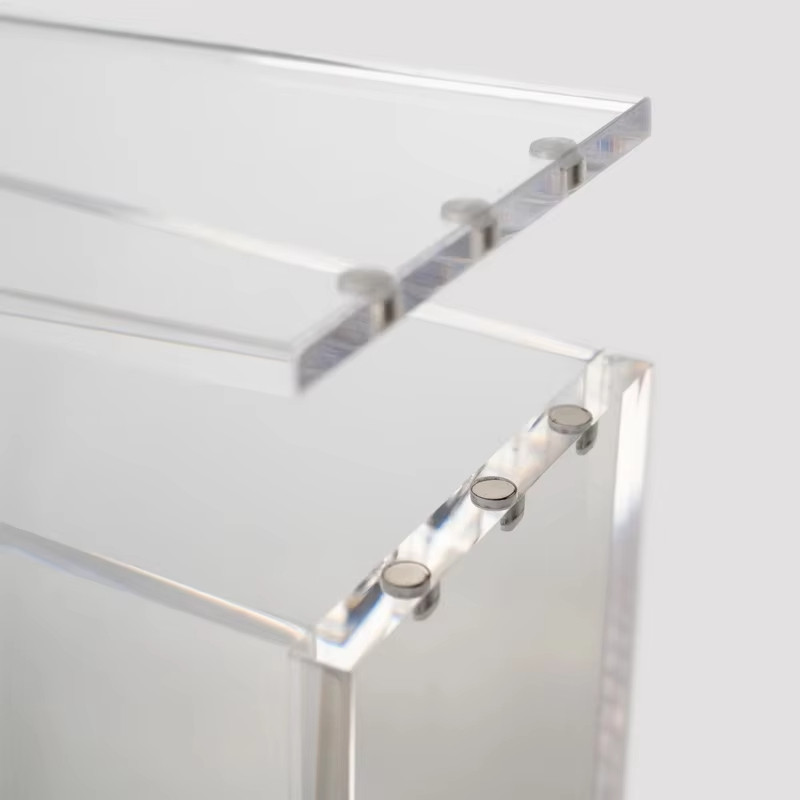
A clear, made-to-fit Pokemon SPC acrylic case protects the flat Super Premium Collection box without the slack that a generic booster box shell leaves around it.
Why Standard Booster Box Cases Fail on Short Boxes
The failure is mechanical before it is cosmetic. When a short box sits in a cavity that is too tall, the sealed carton can move during handling. Shrink wrap rubs against acrylic, edges chip, and in a retail environment the wobble reads as low quality. Worse, the free space traps dust and allows UV light to reach surfaces the case was bought to protect.
The second failure is structural. Acrylic is strong in compression but weak at sharp corners under impact. A case that is too long for its box lets the load shift to one end, so a knock lands on a corner rather than being spread across a face. For importers moving sealed stock between warehouse, store and show, that is exactly the scenario that produces cracked corners and rejected shipments. Sizing is therefore a commercial control, not a detail.
Acrylic Case vs. Cardboard Tray Compared for SPC Storage
Cardboard trays are cheap and light, and for bulk transit they do a job. But once sealed product is being displayed, resold or held as inventory, the comparison changes quickly.
| Feature | Rigid Acrylic Case | Cardboard Tray / Box |
|---|---|---|
| Crush protection | Rigid walls resist stacking and handling loads | Soft walls deform under moderate weight |
| Dust and moisture | Closed enclosure keeps dust and spills off the wrap | Open or loosely folded, dust enters easily |
| UV shielding | Can be specified with UV-filtering acrylic | No meaningful UV blocking |
| Retail display | Clear faces show the sealed box, print and seal | Opaque, must be opened to show product |
| Stackability | Flat lids stack evenly and stay aligned | Crushed corners after a few rows |
| Unit cost at MOQ 100 | Higher per unit, lower per protected value | Lowest upfront cost |
| Fit for sealed investment stock | Purpose-built for long-term holding | Transit and short-term only |
Measuring Internal Cavity for SPC and Half Boxes
Internal cavity is the number that decides whether a case works; external dimensions only decide how it shelves. Measure the sealed box at its widest point, including shrink wrap seams and any label or security tag, then add clearance. A typical Pokemon SPC box measures roughly 14.5 by 3.5 by 7 inches, while the internal cavity of a properly fitted case usually runs about 14.6 by 3.5 by 7.05 inches. That is a clearance of roughly 1.5 to 3 mm per side, enough to slide in without scraping the wrap.
Half booster boxes need their own sizing pass. They are commonly around 5.2 by 2.5 by 4.8 inches, so a half box case cavity near 5.125 by 2.875 by 3.06 inches is what buyers should be quoting. Because Pokemon refreshes box formats regularly, always measure the current production run rather than reusing last season's figures. A supplier who asks for a sample box before quoting custom tooling is protecting you from a whole container of near-misses.

Slim formats such as Japanese and half boxes rarely share tooling with a full-size shell, which is why each box format should be measured on its own.
Measuring Internal Cavity for a Pokemon SPC Acrylic Case
When buyers request a Pokemon SPC acrylic case, the quote should be driven by three numbers: length, depth and height of the internal cavity. Length governs whether the flat box slides in without bowing the sides, depth sets the gap across the narrow face, and height decides lid clearance. Write all three down in millimetres, not in rounded inches, because a 2 mm error is the difference between a press fit and a rattle.
Also confirm whether the case is a lid-on-top design or a sliding or press-fit enclosure. A magnetic lid adds a small internal lip that eats into the cavity, so a case quoted as 14.6 inches long may offer less usable length once the lid is closed. Ask for the cavity drawing, not just the external footprint.

The same shell family can look identical from outside while offering very different internal cavities, so always compare the internal drawing rather than the product photo.
Lid Depth and Clearance: Getting the Fit Right on a Pokemon SPC Acrylic Case
Lid depth is the most underestimated variable in sealed-box display. A lid that drops too far will press on the shrink wrap; one that sits too high leaves a visible air gap that collects dust. A practical target is a lid that closes with about 1 to 2 mm of clearance above the box top under normal humidity, so the acrylic never contacts the wrap but still seals the enclosure.
Clearance also has to respect display intent. Museums and premium retail shelving favour a tighter fit for a crisp silhouette, while warehouse stacking can tolerate slightly more room because the case is not being viewed at close range. Buyers ordering two grades of the same format, one for retail display and one for storage, should state that at the quoting stage so the cavity tolerance is set once, correctly.
Stacking and Maintaining SPC Displays Safely
Short, flat SPC cases stack well because their lids present a large, level surface. Keep loads centred over the vertical walls rather than the unsupported centre of the lid, and cap stacks at a height where the bottom case still sits flat. For retail fixture use, an acrylic riser or category page shelf protector reduces contact pressure and keeps the display readable.
Maintenance is simple if the case is handled correctly. Use a soft microfibre cloth and lukewarm water or a mild acrylic cleaner; never wipe acrylic with alcohol-based solvents or paper towels, which leave micro-scratches that cloud the clarity buyers pay for. Store cases with their lids on so the cavity does not collect dust between seasons.
Wholesale and Retail Notes for Buyers (MOQ, Packaging, Lead Time)
For importers, distributors and store groups, the buying conversation is about MOQ, packaging and lead time as much as millimetres. Custom acrylic display programmes typically start at an MOQ of 100 pieces per design, which keeps a two-size English-and-half-box programme realistic for small and mid-size buyers. Standard formats can often ship from existing stock in smaller quantities; custom cavity tooling usually starts at that 100-piece threshold.
Packaging matters because acrylic is heavy relative to cardboard. Cases ship with protective film and interleaved corner protection, and buyers should confirm carton gross weight and pallet configuration before a container order. Lead time breaks into two phases: sampling, usually a few working days, and production, which for custom cavity work commonly runs in the two-to-three week range. Express air freight via DHL, FedEx or UPS typically takes 5 to 12 days, while sea freight runs 25 to 35 days, so display programmes tied to a product launch should build the sampling window into the schedule.
Retailers should also plan shelf-ready packaging: a branded sleeve, a hang tag or a printed insert raises perceived value and reduces the labour cost of pricing each unit in store. Sourcing from a manufacturer with proven export experience, documented batch inspection and OEM/ODM capability avoids the common trap of a low unit price that is lost again to returns. You can review our acrylic display cases and showcase boxes range or send your box dimensions through the inquiry form for a matched quote, and our OEM/ODM programme covers custom cavities, colours and branding.

For buyers, a fit-matched range across booster bundle, half box and SPC formats lets one supplier cover several shelf positions with consistent packaging and lead times.
About GUARD TCG
GUARD TCG is a trading card accessories manufacturer established in 2009, producing more than 300 million units a year for over 10,000 customers in 70-plus countries, including more than 500 distributors. Our range covers acrylic display cases, card binders, sleeves, toploaders, rigid protectors, storage boxes and carrying cases, with OEM and ODM programmes for buyers who need custom dimensions, colours or branding. Every order runs through full batch inspection before dispatch, we support express air freight (DHL, FedEx, UPS, typically 5 to 12 days) and sea freight (25 to 35 days), and custom display programmes generally start at an MOQ of 100 pieces.
FAQ: SPC and Half Booster Box Cases
Q1: Can a standard booster box case hold a Pokemon SPC box?
Not well. The SPC box is long and flat while a 36-pack booster box is tall and deep, so a standard shell leaves the SPC box sliding and its corners unprotected. A dedicated Pokemon SPC acrylic case with a matched cavity is the correct fit.
Q2: What clearance should a half booster box case have?
Plan for roughly 1.5 to 3 mm per side. Half boxes are small, so excessive tolerance is far more visible than on a full-size box, and the lid gap should stay at about 1 to 2 mm above the sealed carton.
Q3: How many sizes do I need to cover Pokemon sealed formats?
Most trade buyers settle on three: a full booster box size, a half or slim size, and an SPC or premium flat size. Because Pokemon refreshes formats, confirm the current dimensions before locking tooling.
Q4: What is the MOQ for a custom SPC acrylic case?
Custom display programmes commonly start at 100 pieces per design. Sampling usually takes a few working days and production for custom cavities generally runs two to three weeks, before air or sea transit.
Q5: Does UV-filtering acrylic help sealed Pokemon stock?
Yes. UV exposure fades print and can degrade shrink wrap over time, so UV-filtering acrylic is worth specifying for stock that will be displayed near windows or under strong retail lighting.
Conclusion
Sizing a Pokemon SPC acrylic case is a measurement exercise, not a catalogue exercise. Record the length, depth and height of every sealed format you stock, add 1.5 to 3 mm per side, set the lid clearance at 1 to 2 mm, and confirm the fit with a golden sample before a container order. For importers, distributors and retailers, that discipline turns a fragile display purchase into a repeatable programme with predictable packaging, lead times and margin. Talk to GUARD TCG about custom acrylic cases, review our acrylic display cases range, or send your box dimensions through the inquiry form for a matched quote.