Sealed Product Case Fit Checklist: Measure Before You Buy
- Share
- publisher
- GUARD TCG Team
- Issue Time
- Oct 14,2026
Summary
A step-by-step sealed product case fit checklist: measure length, width, height, and corner radius, add clearance, and compare against the case internal cavity to avoid crushed corners, rattling displays, and returns, with wholesale MOQ and lead time guidance.
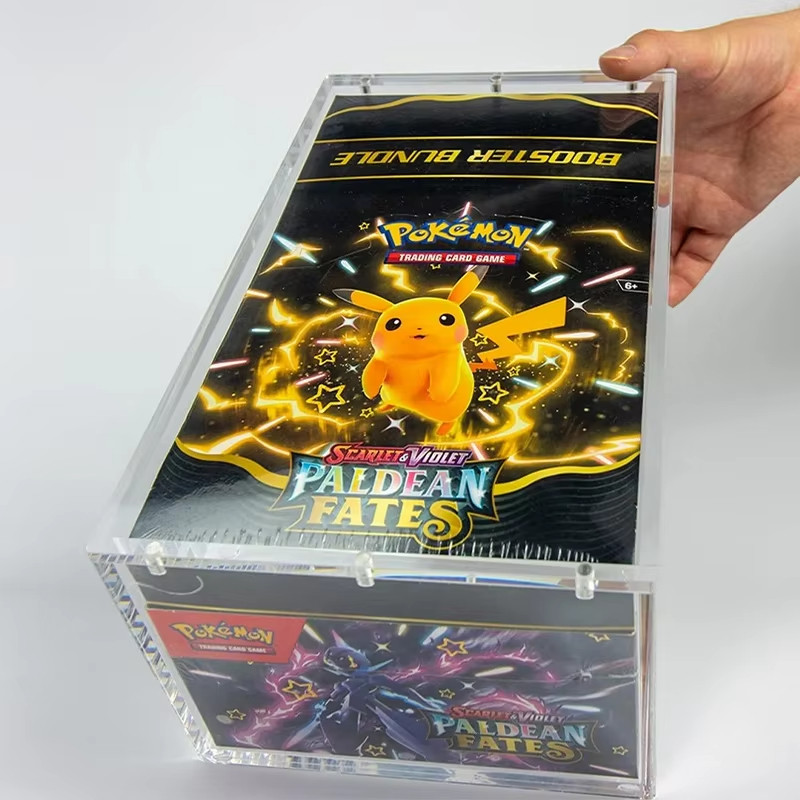
Sealed Product Case Fit Checklist: Measure Before You Buy
A sealed product case fit checklist is a short measurement routine you run before buying: record length, width, and height of the box, add clearance for the lid, check the corner radius, then compare those numbers against the case's internal cavity. Doing this first prevents crushed corners, rattling displays, and returns. For retailers and importers ordering by the case or by the carton, the rule is simple: measure the product, not the marketing photo.
Why Measuring Beats Guessing When Buying a Display Case
Sealed TCG product comes in wildly different footprints: booster boxes, half booster boxes, booster bundles, ETBs, UPCs, and Japanese-market boxes all use different dimensions, and print runs can drift slightly between sets. A case that is sized for one format will not fit another. Guessing based on a product photo is the most common cause of returns, because a case can look right in the listing yet be a few millimeters too tight or too loose in real life. A quick measurement routine removes that guesswork entirely.
What Happens When a Sealed Product Case Does Not Fit
A too-tight case presses on the box corners and can crush them or tear the shrink wrap when you force the lid. A too-loose case lets the box slide and rattle, which scuffs the wrap and chips acrylic corners over time. Either way, the sealed value takes a hit. The fix is almost always the same: the buyer measured the product's outer box rather than the case's inner cavity, or skipped the lid clearance. Measuring twice before ordering is cheaper than a single return.

Internal Cavity vs. External Dimensions Compared
The dimension that matters is the case's internal cavity, not its external footprint, because wall thickness and lid depth eat into the usable space. A case advertised as "fits a booster box" may be measured on the outside, leaving the inside a few millimeters short. The table below shows what to compare and why.
| Dimension | What to check | Why it matters |
|---|---|---|
| Length | Internal left-to-right cavity | Box must slide in without bending corners |
| Width | Internal front-to-back cavity | Prevents side pressure on the wrap |
| Height | Internal floor-to-lid clearance | Lid must close over the tallest point |
| Corner radius | Case corner rounding vs. box | Square boxes need square-ish corners |
| Lid depth | Recess the lid adds when closed | Affects total closed height and stack |
| Tolerance | 3 to 5 mm added clearance | Allows easy in-and-out without rattle |
The Five Measurements Every Sealed Product Case Fit Checklist Needs
A complete sealed product case fit checklist records five numbers. First, measure the box length across its longest side. Second, measure width across the shorter side. Third, measure height from the base to the highest point, including any lid or wrap bulge. Fourth, note the corner radius, since a rounded case will not seat a sharp-cornered box. Fifth, add your working clearance, typically 3 to 5 mm on each axis, before comparing to the case's stated internal cavity. Write these down; do not trust memory between browsing and ordering.

Corner Radius, Lid Clearance, and Tolerance
Three details trip up most first-time buyers. Corner radius: a sharp-cornered box in a heavily rounded case leaves empty space at the corners and looks sloppy. Lid clearance: the lid, when closed, must clear the box's tallest point without pressing, or it will crease the wrap every time. Tolerance: adding 3 to 5 mm per axis keeps the fit snug enough to prevent sliding yet loose enough to remove the box without forcing. Check all three against the actual box in hand, not a catalog rendering.

A Repeatable Sealed Product Case Fit Checklist for Every Order
Turn the routine into a repeatable step so every order, and every team member, follows the same standard. Measure the box, record the five numbers, add clearance, compare against the supplier's internal cavity spec, and confirm the lid and corner profile before checkout. Keep a spreadsheet of your most-sold box formats with their confirmed case sizes, so reorders skip the measuring entirely. For a growing catalog, this checklist is the difference between a shelf of misfit cases and a storage program that scales.
Wholesale and Retail Notes for Buyers (MOQ, Packaging, Lead Time)
Buyers ordering a sealed product case fit checklist across a product line should confirm three commercial points before committing. Standard MOQ for stock acrylic cases starts around 100 units per size, with OEM and ODM options for custom sizes and branding. Packaging is protective film plus corrugated carton to prevent transit scratches, and lead time runs roughly 15 to 25 days for production with 5 to 12 days by DHL, FedEx, or UPS express, or 25 to 35 days by sea for volume. Always request a sample, measure it against your own sealed boxes, and confirm internal dimensions before a bulk order. For custom-fit programs, see our OEM/ODM case manufacturing page.

About GUARD TCG
GUARD TCG is a card protection and display manufacturer founded in 2009, producing more than 300 million units a year for customers in over 70 countries, with 10,000+ customers and 500+ distributors worldwide. We provide OEM and ODM services with a 100-unit MOQ, full-batch quality inspection, and express or sea shipping. For help sizing a case or building a sealed product case fit checklist for your catalog, contact us through the inquiry page.
FAQ: Sealed Product Case Fit Checklist
Q1. What is a sealed product case fit checklist?
It is a short measurement routine: record box length, width, and height, note the corner radius, add 3 to 5 mm clearance, then compare against the case's internal cavity before you buy.
Q2. Do I measure the box or the case?
Both. Measure your box for its real footprint, and confirm the case's internal cavity, because external dimensions include wall thickness and lid depth that reduce usable space.
Q3. How much clearance should I leave in a sealed product case?
About 3 to 5 mm on each axis. This keeps the box from rattling while still allowing easy removal without forcing the lid.
Q4. Can I order cases in custom sizes for unusual boxes?
Yes. GUARD TCG offers OEM and ODM custom acrylic cases with a 100-unit MOQ. Send your measurements and we will confirm the internal cavity before production.
Conclusion: Measure First, Buy Once
A sealed product case fit checklist takes two minutes and saves you crushed corners, rattling displays, and return shipping. Measure the box, add clearance, compare against the internal cavity, and confirm the lid and corner profile before ordering. For retail and wholesale programs, browse our display case catalog or use the inquiry page to size custom runs.