TCG Accessory Trends for 2026: What Retailers Should Stock
- Share
- publisher
- GUARD TCG Team
- Issue Time
- Sep 26,2026
Summary
The 2026 TCG accessory trends worth stocking: graded-card protection (slab bumpers, SlabMags), display-grade acrylic for sealed product, and custom printed sleeves and playmats. Covers who should stock what, a practical SKU framework, MOQ and lead-time guidance, and how GUARD TCG supports retailers buying factory-direct.
TCG Accessory Trends for 2026: What Retailers Should Stock
For 2026, three accessory trends are worth building shelf space around: the graded-card aftermarket keeps expanding (slab bumpers, SlabMags, magnetic cases), display-grade acrylic for sealed product goes mainstream (ETBs, Ultra Premium Collections and booster boxes), and customization moves downmarket as printed sleeves and custom playmats become normal catalogue lines. Underneath all three sits the dependable volume base — matte sleeves, playmats and deck boxes. This guide explains the reasoning behind each trend, compares them side by side, and gives a practical SKU framework so a card shop or online seller can order the right depth without tying up too much cash.
What Is Driving TCG Accessory Demand in 2026?
Accessory demand is downstream of card-collecting behaviour, and in 2026 that behaviour has three engines. First, grading volume: submissions to PSA, BGS and CGC have stayed elevated for several years, and every graded card that comes back in a slab creates a second purchase — a bumper, sleeve or display case to protect the slab itself. PSA's own submission guidelines explicitly warn that slabs can crack or chip in transit, which is exactly the problem aftermarket slab protection solves.
Second, sealed-product collecting. Modern collectors treat ETBs, booster bundles and Ultra Premium Collections as assets, and sealed product is far more fragile than a binder of loose cards. Retailers report that sealed product buyers will pay for acrylic that keeps boxes square and UV-protected.
Third, the casualization of customization. Printed sleeves and custom playmats used to be a vendor-table novelty; today they are a standard wholesale line, because small creators and local game stores order short runs as branded merchandise. Industry market reporting from ICv2 and TCGplayer category data both point to accessories as one of the steadier, higher-margin parts of the hobby retail mix — less spiky than single-card sales, but easier to forecast.
Trend #1: The Graded-Card Aftermarket Keeps Expanding
The clearest trend heading into 2026 is that protecting the slab is now its own product category. Three sub-segments matter:
- Slab bumpers and SlabMags: a bumper cushions the edges of a graded holder; a SlabMag is a rigid magnetic shell that houses the entire slab. Both sell to collectors who store slabs upright or ship them.
- Slab sleeves and bags: the cheapest entry point and the highest repeat rate — collectors buy them in packs of 50 or 100 and rebuy whenever they submit another batch.
- Acrylic display cases for slabs: the premium tier, sold to collectors who display keys rather than file them in a box.

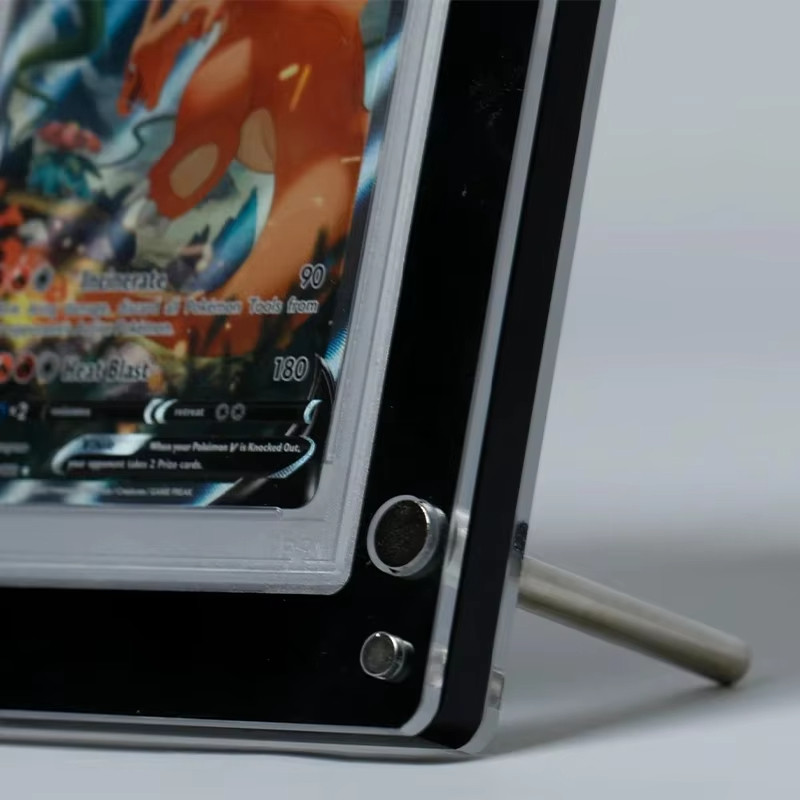
Magnetic slab shells and bumpers are the fastest-moving graded-card accessory category; they protect the holder without hiding the label.

Multi-slab acrylic cases let a collector store and show a graded set in one unit — a format rising fast with set collectors.
The reason this trend has legs is supply-side: each new release cycle adds more cards worth grading, and the graders' slab dimensions are effectively standardised, so one protective SKU fits a huge slice of the market. For a retailer, that means low SKU complexity and high repeat purchase — the ideal combination.
Trend #2: Display-Grade Acrylic Goes Mainstream
Acrylic display cases have jumped from "serious-collector upgrade" to routine stock. The shift is being driven by sealed-product values: when an unopened ETB or Ultra Premium Collection appreciates, the owner starts caring about corners, dents and sun fading, and an acrylic case becomes a rational purchase rather than a vanity one.
Two formats are winning:
- Slide-and-stack cases for ETBs and booster boxes, which let a collector build a display wall that still opens for inspection.
- Screw-down and magnetic cases for graded slabs and single showcase items, which present a card as a piece of decor rather than storage.

Display-grade acrylic doubles as store decor: the same case that protects a slab also merchandises it.
Retail angle: acrylic is the highest-ticket accessory a store can stock per cubic metre of shelf, and it photographs brilliantly for online listings, which matters when a shop's Instagram page is doing half the selling. The trade-off is shipping weight and breakage, which is why buying factory-direct with proper inner packing matters more here than in any other accessory category.
Trend #3: Customization Moves Downmarket
The third trend is the one most retailers underestimate: customization is no longer a B2B-only service. Printed card sleeves, holographic art sleeves and custom playmats are being ordered in small batches by creators, local clubs and even individual tournament organisers who want a house identity.
What changed is minimum order quantity. Standard, unbranded accessories have long been available from around 100 pieces, and the custom-print tier has come down far enough that a store can commission branded sleeves or a mat for a single season of events without a big capital commitment. For a shop, that changes customization from a "someday" project into a marketing line item.

Custom printed sleeves are the entry point for store-branded merchandise; they sell both as product and as advertising.

Matte and clear retail sleeves stay the highest-rebuy line in the catalogue — the volume base every trend sits on.
2026 TCG Accessory Trends at a Glance
| Trend | What It Covers | Typical Buyer | Stock Depth |
|---|---|---|---|
| Graded-card aftermarket | Slab bumpers, SlabMags, slab sleeves, magnetic slab cases | Graders, flippers, slab collectors | High — fast repeat, low SKU count |
| Display-grade acrylic | ETB / booster box cases, screw-down and magnetic showcase cases | Sealed collectors, display buyers | Medium — high ticket, higher shipping cost |
| Customization | Printed sleeves, holographic art sleeves, custom playmats | Creators, clubs, event organisers | Low–medium — project based, order to demand |
| Player consumables | Matte sleeves, inner sleeves, penny sleeves | Every player, every week | High — the volume base, rebuy constant |
| Play surface & deck storage | Playmats, deck boxes, binders | Competitive and casual players | Medium — steady, event-driven spikes |
| LP grading accessories | Slab bags, toploaders, card savers for submission | Anyone shipping to PSA or BGS | High — rises with every submission season |
| UV protection | UV-filtering cases, sleeves and display covers | Long-term collectors, display owners | Medium — attach rate to display purchases |
Who Should Stock Which Trends?
Not every store needs every trend at full depth. A useful split:
- Local game stores: lead with player consumables, playmats and deck boxes, then add slab sleeves and a small acrylic selection. Your footfall buys repeats, not one-off luxuries.
- Online card sellers: graded-card protection and submission supplies are the natural add-on to every card you post; bundle a toploader or slab sleeve with higher-value singles.
- Sealed-product specialists: acrylic display cases are core, not optional, and should be merchandised alongside the sealed product they protect.
- Event organisers and clubs: custom printed sleeves and branded playmats convert your identity into revenue and reduce reliance on generic stock.
How to Choose What to Stock: A Practical SKU Framework
Work through four questions before you place a wholesale order:
- What does my customer already buy from me? Accessories should attach to existing behaviour. If you sell singles, stock submission and slab supplies first.
- What is the rebuy rate? Sleeves, slab sleeves and toploaders rebuy constantly; display cases often sell once per customer. Weight your cash towards rebuy.
- What is the shipping risk? Acrylic is heavy and can crack. Buy factory-direct with tested packaging, and check the supplier's QC and packing standards before you scale.
- What is the MOQ and lead time? Standard accessories often start around 100 pieces, while custom print runs are quoted per project. Match the order size to a realistic sell-through window so you never sit on a year of inventory.
For the buying mechanics, see our guide to buying TCG accessories wholesale and our full product range for current formats.
Best Practices for Buying 2026 Accessory Trends
- Buy factory-direct where it counts. For acrylic and custom print, cutting out the trading company is what protects your margin and your lead time.
- Standardise on a few protective formats. Graded slabs are dimensionally consistent, so one good bumper or SlabMag SKU covers a large share of demand.
- Merchandise protection next to value. Put slab cases near graded singles and acrylic near sealed product; attachment selling beats shelf classification.
- Treat customization as marketing. A branded sleeve or mat for your event season pays for itself in visibility, not just in unit sales.
- Check QC and packing. For any accessory, batch inspection and tight inner packing are the difference between a 5-star review and a returns pile.
- Buy for the season, not the year. Accessory demand clusters around set releases; time your reorders to the calendar, not the warehouse discount.
About GUARD TCG
GUARD TCG has manufactured trading card accessories and protective packaging since 2009, producing over 300 million pieces a year for customers in more than 70 countries. The factory serves 10,000+ clients and 500+ distributors, and offers OEM/ODM and private-label programs with standard-order minimums from 100 pieces. Quality control inspects every production batch, and shipping runs through DHL, FedEx and UPS in 5–12 days or by sea in 25–35 days. Product specifications such as 50-micron card sleeves, 35PT toploaders and 92–99% UV-blocking materials are quoted directly from the production line, which is why we publish real numbers rather than marketing copy. To discuss stocking 2026 accessory trends, contact the GUARD TCG team or send an inquiry.
FAQ
Which TCG accessory categories will be hottest in 2026?
The strongest categories are graded-card protection (slab bumpers, SlabMags, slab sleeves), display-grade acrylic for sealed product and graded slabs, and custom printed sleeves and playmats. Player consumables such as matte sleeves and toploaders remain the reliable volume base underneath all three.
Do I need to stock acrylic if I am a small shop?
Not in depth. Start with one or two formats that match what you already sell — for example, a slide-and-stack case for ETBs if you sell sealed product, or a screw-down case if you sell graded singles.
What is the minimum order for custom printed sleeves?
MOQ depends on the print method and artwork. Standard unbranded accessories typically begin around 100 pieces, while custom printed runs are quoted per project; ask for a quote that lists MOQ, lead time and packaging.
Does card storage really need UV protection?
Yes, if a card is displayed. UV light fades inks and yellows borders over time, and display-grade cases and UV-filtering sleeves block the majority of it. Store the highest-value cards away from direct sunlight regardless of material.
How much of my accessory budget should go to rebuy items?
A common working split is roughly two-thirds to rebuy categories (sleeves, slab sleeves, toploaders) and one-third to higher-ticket, slower-turn items such as acrylic and custom runs — but weight it to your own sell-through data.
Conclusion
The 2026 accessory picture is clear: protect the slab, display the sealed product, and personalise the player experience. Graded-card aftermarket accessories and display-grade acrylic are the growth stories, customization is the differentiator, and player consumables are still the base that pays the rent. Retailers who order to those three trends — factory-direct, with sensible MOQs and batch-checked quality — will find 2026 a steadier year than the single-card cycle alone would suggest, and a more profitable one too.