UV Blocking Ratings Explained: 92% vs 99% Protection for Card Cases
- Share
- publisher
- GUARD TCG Team
- Issue Time
- Nov 3,2026
Summary
A UV blocking card case filters ultraviolet light to slow ink and cardboard fading. This guide explains what 92% vs 99% ratings measure, why the gap matters, and how importers and retailers choose the right spec for any display.
UV Blocking Ratings Explained: 92% vs 99% Protection for Card Cases
UV blocking ratings describe how much ultraviolet light a card case filters, expressed as a percentage: 92% blocks most UV, while 99% blocks nearly all of it. Higher ratings better protect inks and cardboard from fading, but UV filtering only helps if visible light exposure is also limited. Match the rating to how much sunlight the display receives. For importers and retailers stocking a UV blocking card case, the rating is a verifiable spec that decides how you position the product — and how honestly you can promise long-term protection to collectors.
What a UV Blocking Rating Actually Measures
A UV blocking rating is the share of ultraviolet radiation a material stops, stated as a percentage. A 92% case lets 8% of incoming UV through; a 99% case lets only 1% through. The number is usually measured across the fading-relevant UV band of roughly 280 to 400 nanometers, which covers UVA and UVB, the two ranges that reach indoor displays and do the most photochemical damage to inks and paper. What matters for a collector or a buyer is not the glassy look of the acrylic but what the number means for the cards sitting inside it over months and years.

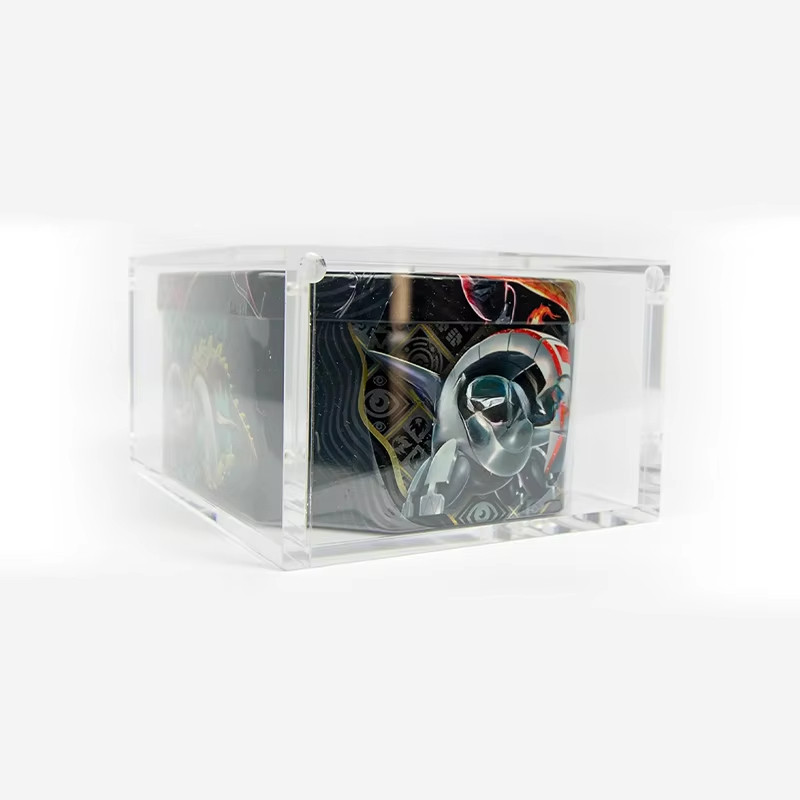
A clear acrylic UV blocking card case keeps a sealed product visible while filtering the ultraviolet light that would otherwise fade its inks over time.
Why 92% and 99% Are Not Marketing Fluff
The gap between 92% and 99% sounds small but is much larger than it appears, because UV damage is cumulative and irreversible. With a 92% case, 8% of harmful UV reaches the card continuously; with 99%, only 1% does — an eightfold reduction in the dose the card receives every day. Standard acrylic naturally blocks most UVB but often only about 70% of UVA, which is precisely the range that drives long-term color loss. Museum-grade and specialized UV-filtering acrylic add absorbers or co-extruded layers to hold 98-99% blocking across the full spectrum, which is why they meet the archival standards galleries use for irreplaceable artwork. For a card intended to hold value, the difference shows up in six to twelve months on a bright shelf.
92% vs. 99% UV Protection Compared
The table below summarizes how the two common ratings stack up across the factors that matter to collectors and to buyers writing a product spec.
| Factor | 92% UV blocking | 99% UV blocking |
|---|---|---|
| UV allowed through | 8% | 1% |
| UVA coverage | Partial (often ~70% UVA) | Full spectrum, 280-400 nm |
| Protection level | Moderate | Museum-grade / archival |
| Fading risk over years | Noticeable on bright displays | Minimal long-term |
| Best for | Dark interiors, budget lines | Windows, high-value, long-term |
| Relative unit cost | Lower | Higher |

For sealed booster boxes displayed in a retail case or a bright home shelf, a higher UV rating is the difference between a product that ages and one that holds its colors.
How to Choose a Rating for Your Display Location
Choose the rating by where the case will actually live, not by the card's face value alone. Direct sunlight is the most damaging source and demands 99% or better if the case sits near a window; fluorescent office or shop lighting is moderate and still benefits from high UV filtering; LED lighting emits very little UV and is the safest indoor choice. A 92% case is a sensible floor for cards kept in a dark cabinet or a low-light interior, where the remaining 8% transmission has almost nothing to work with. Match the spec to the room, because the same case that is overkill in a closet can be inadequate on a sunny counter.
Visible Light, Heat, and Combined Exposure
UV filtering is necessary but not sufficient, because visible light also fades ink and heat warps cardboard. Museum conservation guidance keeps UV content low while also limiting visible light intensity and total exposure hours, because the damage is a dose of intensity multiplied by time. Bright LED light is far safer than sunlight, but no light source is perfectly harmless over years. Heat is the second enemy: acrylic traps warmth, and temperature swings can bow a case and stress the card inside. The best setup pairs a high-UV case with LED lighting, moderate room temperature, and distance from direct sun.

Premium sealed products like UPCs are exactly the kind of high-value display where a 99% UV blocking card case earns its cost.
Maintaining UV Protection Over the Years
UV protection is a property that can degrade with time and handling. Scratches, clouding, and chemical cleaners can reduce clarity and, over very long periods, UV absorbers in some formulations slowly lose effectiveness. Keep the case clean with a soft, non-abrasive cloth and mild soap, avoid ammonia-based glass cleaners that can craze acrylic, and inspect displays once or twice a year for yellowing or fogging. Replace scratched panels on high-value displays, because a compromised surface is both an optics problem and a weakened barrier between the card and the light source.
Wholesale and Retail Notes for Buyers (MOQ, Packaging, Lead Time)
For importers and distributors, the UV rating is a claim you must be able to stand behind, so ask for the specification in writing rather than accepting a vague "UV resistant" label. GUARD TCG acrylic display cases start at a 100-unit MOQ with tiered bulk pricing and full OEM/ODM support for custom sizes, branding, and packaging, so a retailer can carry a UV blocking card case line under its own identity. Production lead time for stock cases runs 15-25 days, with 5-12 day express delivery by DHL, FedEx, or UPS and 25-35 days by sea freight for full containers. Every batch undergoes full inspection, and the UV specification can be documented for your product pages, which is how a "99% UV protection" claim converts into buyer confidence at the shelf.

Japanese special boxes and other premium sealed items are a fast-growing niche where documented UV protection adds clear retail value.
About GUARD TCG
GUARD TCG is a card protection and display manufacturer founded in 2009, producing more than 300 million units a year for customers in over 70 countries, with 10,000+ customers and 500+ distributors worldwide. We manufacture acrylic display cases with documented UV-filtering specifications, plus card sleeves, binders, deck boxes, and graded-slab accessories, all backed by a 100-unit MOQ, full-batch quality inspection, and OEM/ODM programs. For a UV blocking card case program, start with our OEM/ODM page, browse the acrylic display cases catalog, or reach us through the inquiry page.
FAQ: UV Blocking Ratings Explained
Q1. What does a 92% vs 99% UV blocking rating actually mean?
It means the case filters 92% or 99% of incoming ultraviolet light, letting 8% or 1% through respectively. The 99% rating is about an eightfold reduction in UV dose, which matters because UV damage is cumulative and irreversible.
Q2. Do I need 99% UV protection for cards in a dark room?
Not necessarily. A 92% UV blocking card case is usually adequate for dark cabinets and low-light interiors, because the small amount of UV that passes through has almost nothing to act on. Reserve 99% for windows, bright shelves, and high-value sealed or graded items.
Q3. Does UV blocking stop all fading?
No. UV filtering reduces the most damaging part of light, but visible light and heat also fade ink and warp cardboard over time. Pair a high-UV case with LED lighting, moderate temperature, and distance from direct sunlight for the best result.
Q4. How can a buyer verify a case's UV rating?
Ask the supplier for the specification in writing, including the wavelength range covered, rather than accepting a vague "UV resistant" label. Reputable manufacturers can document the formulation and provide the rating for your retail product pages.
Conclusion
A UV blocking rating is a real, measurable property, and the jump from 92% to 99% is far more meaningful than the small number suggests. Match the rating to the display location, remember that UV filtering is one part of a lighting-and-heat strategy, and for buyers, source cases with a documented specification you can stand behind. To build or stock a UV protection line, browse our acrylic display cases or reach us through the inquiry page.