Yu-Gi-Oh! Booster Box Acrylic Cases: Protecting 24-Pack Displays
- Share
- publisher
- GUARD TCG Team
- Issue Time
- Oct 10,2026
Summary
A Yu-Gi-Oh booster box acrylic case sized for the 24-pack display keeps sealed corners crisp for grading and resale. Learn how to measure the footprint, choose wall thickness and lid fit, and order OEM/ODM cases with MOQ 100 for retailers and importers.
Yu-Gi-Oh! Booster Box Acrylic Cases: Protecting 24-Pack Displays
Yu-Gi-Oh! booster boxes hold 24 packs and are lighter yet longer than many modern displays, which makes sizing the acrylic cavity critical. A Yu-Gi-Oh booster box acrylic case that is too tight bends the box corners; too loose and the display slides when lifted. A properly fitted acrylic case keeps the sealed 24-pack display protected for collectors, retailers and importers alike — preserving crisp corners for grading and resale while turning inventory into shelf-ready merchandise. For B2B buyers, the right case is a specification decision, not an accessory: match the cavity to the box footprint, choose the correct wall thickness, and a single enclosure design protects an entire carton of stock.
Why Yu-Gi-Oh! 24-Pack Displays Need Their Own Case
Yu-Gi-Oh! booster displays sit in an unusual size bracket. Unlike the tall, heavy Elite Trainer Boxes or the chunky 36-pack Pokémon displays, a standard Yu-Gi-Oh! booster box is a long, slim carton built around 24 booster packs. Konami has kept this format remarkably consistent across core sets, which is good news for buyers — it means one well-specified acrylic case fits years of releases — but it also means a generic "booster box" case is frequently the wrong tool.
The risk is concentrated in the corners. A Yu-Gi-Oh! box is lighter than it looks, so handlers assume it is tough and stack it, slide it, or toss it into totes. Because the carton is long and thin, any impact is transmitted along its length and almost always lands on a corner. A dedicated Yu-Gi-Oh booster box acrylic case spreads that load across rigid acrylic walls instead of letting it bite into the printed board.
For retailers and importers the same logic scales up: sealed Yu-Gi-Oh! stock moves from a distribution centre to a retail floor, onto a convention table, or into a collector's display cabinet — each stop is an opportunity for a crushed corner that quietly devalues the unit before it is ever opened.
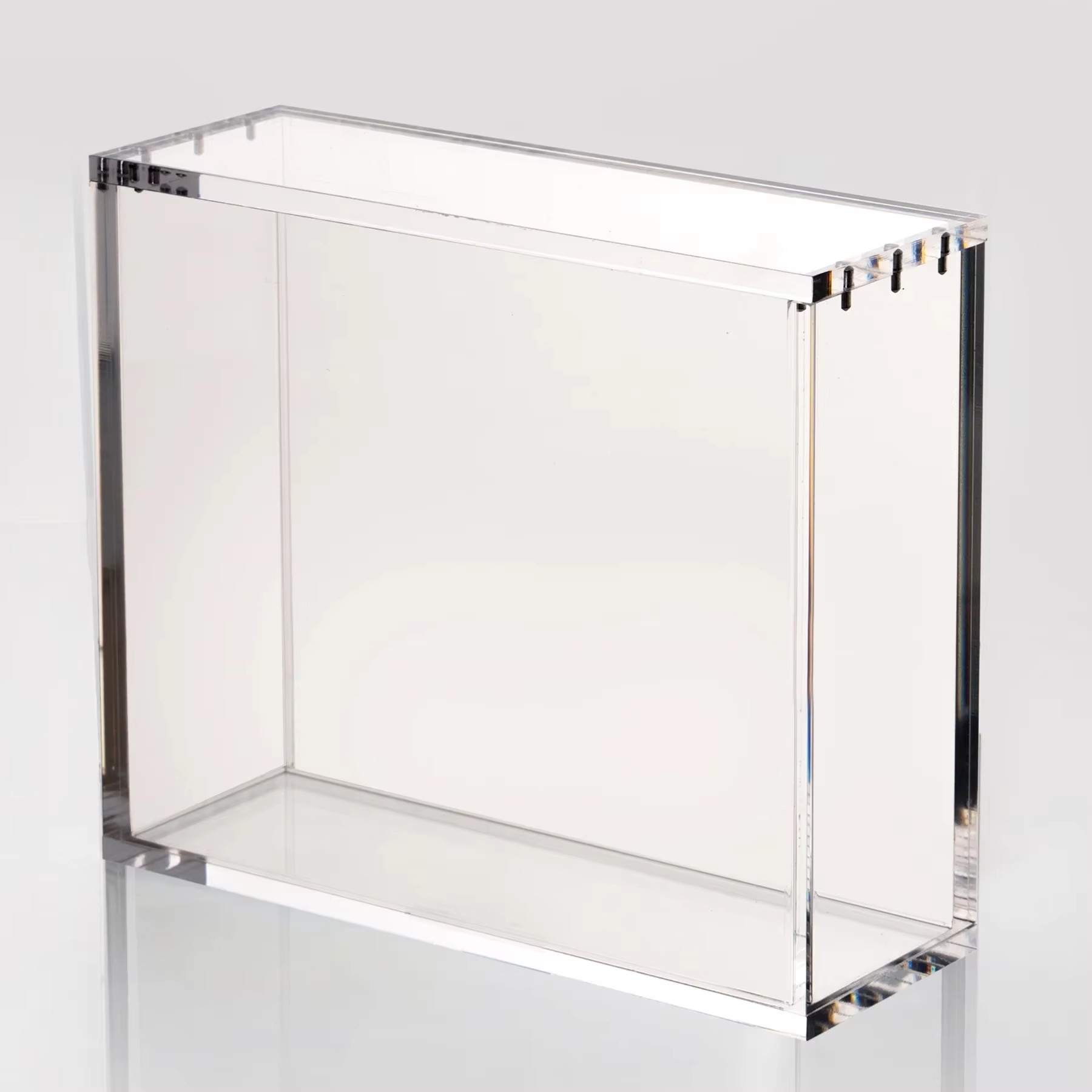
A fitted acrylic enclosure sized for the long, slim 24-pack Yu-Gi-Oh! display format, keeping the sealed carton crisp and shelf-ready.

What Corner Crush Does to Sealed Yu-Gi-Oh! Value
Sealed product grading has moved from a niche service into a mainstream pricing signal. PSA now grades sealed booster boxes and packs as whole units, and its condition criteria for sealed product mirror its card grading: corner damage is the most heavily penalized flaw. A single crushed corner can knock a sealed box from a PSA 10 down to an 8 or lower, and on the secondary market that gap routinely represents a 40–60% drop in realised value (industry estimate based on TCGplayer and eBay sealed-listings history).
This matters even for buyers who never slab anything. Graders set the reference prices that raw sealed sellers quote against, so the entire market — from a collector selling one box to a distributor moving a pallet — feels the effect of a dented corner. Protecting corners is therefore not cosmetic; it is the highest-leverage protection decision you can make for sealed Yu-Gi-Oh! product.
An acrylic case also guards the softer, less obvious damage: surface scuffs on the cellophane, sun-faded artwork, and the dust film that makes a sealed box look "aged" on a retail shelf. None of these are as dramatic as a crushed corner, but together they shift a buyer's perception of condition, which is what sealed value is ultimately priced on.
Acrylic Case vs. Cardboard Storage Compared for YGO
Retailers and collectors often store sealed Yu-Gi-Oh! boxes in the cardboard carton they arrived in. That approach is cheap and fine for short-term warehousing, but it is not a display solution and it does not stop corner crush. Here is how a rigid acrylic case stacks up against plain cardboard storage for 24-pack displays.
| Factor | Acrylic Display Case | Cardboard Storage |
|---|---|---|
| Corner crush resistance | High — rigid walls absorb and spread impact | Low — corners deform under stacking |
| Dust and handling oils | Blocked by a closed lid | Exposed whenever the carton is open |
| UV protection | Available with UV-inhibiting acrylic | None |
| Retail visibility | Clear showcase that displays the product | Hides the product entirely |
| Sealed resale value | Preserves corners for grading and resale | Does nothing to protect condition |
| Reusable lifespan | Years of reuse across multiple sets | Disposable, breaks down in storage |
| Unit cost | Higher up front, amortised over reuse | Lowest initial cost |
Cardboard is not the enemy — it is the wrong layer for a product whose entire value lives in its sealed condition. An acrylic case is the upgrade you make once the box is meant to be seen, sold, or kept for years.
Acrylic booster box cases like this one use the same cavity-sizing logic that makes a Yu-Gi-Oh booster box acrylic case fit the slim 24-pack format.

How to Choose: Measuring the Yu-Gi-Oh! Booster Box Footprint
The single most important spec for a Yu-Gi-Oh booster box acrylic case is the internal cavity, and that starts with the box footprint. Retailer-listed dimensions for standard 24-pack Yu-Gi-Oh! displays run roughly 25 cm long by 5 cm deep (about 9.8 in × 2 in), though the exact figure shifts slightly between sets — allow for roughly ±0.5 cm of variance (industry estimate). The long, slim profile is what trips up generic cases designed for thicker Pokémon or MTG displays.
Before ordering, measure the actual stock you carry rather than trusting a memory of the size. Three checks matter:
- Length: the internal length must clear the box without forcing, or the ends will crush.
- Depth and height: the cavity should be close to the box's actual cross-section so the display does not rattle or slide when lifted.
- Lid clearance: leave enough headroom for the lid to seat without pressing on the box's top face.
A good rule of thumb for B2B buyers: if you stock multiple Yu-Gi-Oh! sets, standardise on one cavity sized to the largest box in your range and accept a snugger fit on smaller sets, rather than maintaining a different case per release.
Wall Thickness and Lid Fit for Long Boxes
Because a Yu-Gi-Oh! display is long and slim, the case's structural work happens along its length. Thin acrylic walls flex visibly when a 24-pack box is inside, and that flex is exactly what lets a corner take a knock. Look for walls thick enough to stay rigid across the full span — typically several millimetres — rather than a thin "display sleeve" that only looks protective.
Lid design is the second half of the equation. A snug, well-seated lid keeps dust out and stops the box from shifting, while a loose lid both admits dust and rattles. For a long box, a lid that closes evenly across the full length matters more than it does on a compact case, because any warp is amplified over a longer span.
For wholesale and retail use, prefer a case that can be opened and closed repeatedly without wearing, since demo stock gets handled by many people in a day.
Best Practices and Common Mistakes When Fitting YGO Cases
Most returns and complaints around booster box cases trace back to a handful of avoidable mistakes:
- Buying a generic "booster box" case. Cases sized for 36-pack Pokémon displays leave a Yu-Gi-Oh! box rattling in oversized space.
- Forcing a tight fit. If the box needs pressure to seat, the corners are already under load before any impact happens.
- Ignoring UV. Stock displayed near a window fades faster than most sellers expect; UV-inhibiting acrylic is a cheap hedge.
- Skipping a dust seal. A case with an uneven lid gap slowly fills with dust, which reads as "old stock" to buyers.
The best practice is boring but reliable: measure once, specify the cavity to the box, and buy from a supplier who can confirm wall thickness and lid fit before the first unit ships.
Booster box acrylic cases from GUARD TCG cover a range of slim TCG display formats using the same fit-first design approach.

Maintaining Sealed Yu-Gi-Oh! Displays Over Time
A case protects the box, but the case itself still benefits from basic care. Wipe the acrylic with a soft, non-abrasive cloth and avoid solvent cleaners that can haze the surface. When stacking cased displays, keep the weight off the lids and corners, and store away from direct sunlight and heat sources even if the acrylic is UV-rated.
For sealed product held long-term, a stable environment beats any case on its own. Aim for a cool, dry, temperature-stable location; the case then handles the mechanical and handling risks while the environment handles temperature and humidity swings.
This matters for collectors holding sealed Yu-Gi-Oh! boxes for years, and just as much for distributors whose stock sits in a warehouse between seasons.
Wholesale and Retail Notes for Buyers (MOQ, Packaging, Lead Time)
For importers, distributors and retail chains, a Yu-Gi-Oh booster box acrylic case is a stockable accessory with real margins. At GUARD TCG, the wholesale model is built around OEM and ODM work with a minimum order quantity of 100 pieces, which makes it practical to commission a cavity sized exactly to your Yu-Gi-Oh! inventory rather than settling for an off-the-shelf compromise.
- MOQ: 100 pieces per specification, with full OEM/ODM customisation available for branding, cavity size and wall thickness.
- Packaging: individual poly-bagging and carton packaging to protect the cases themselves in transit.
- Lead time: express courier (DHL, FedEx, UPS) in 5–12 days, or sea freight in 25–35 days for volume orders.
Every production batch passes full inspection before dispatch, so a retailer can reorder the same spec months later and receive an identical fit. For buyers building out a complete sealed-product protection range, the same OEM run can cover multiple TCG display formats — including the slim Yu-Gi-Oh! footprint — under one PO. Learn more on our OEM/ODM page or reach out through our inquiry form.
A fitted acrylic showcase for a sealed Yu-Gi-Oh! 24-pack display, ready for retail shelving or collector display.

About GUARD TCG
GUARD TCG is a trading card protection and display manufacturer founded in 2009, producing more than 300 million pieces a year for customers in 70+ countries. We serve 10,000+ customers and 500+ distributors with OEM/ODM acrylic display cases, card sleeves, binders and storage, all backed by batch-level quality inspection. For a deeper look at how display cases preserve sealed product value across formats, see our guide to booster box display cases or browse the full acrylic display case range.
FAQ: Yu-Gi-Oh! Booster Box Acrylic Cases
Q1. Do Yu-Gi-Oh! booster boxes all share the same size?
Core sets are very consistent, but allow roughly ±0.5 cm between releases, so measure your actual stock before specifying a cavity.
Q2. Will a case built for a Pokémon booster box fit a Yu-Gi-Oh! box?
Usually not well. Pokémon displays are thicker and differently proportioned, so a Yu-Gi-Oh! box will slide in the oversized cavity.
Q3. Does an acrylic case stop UV fading?
Only if it is made with UV-inhibiting acrylic. Standard clear acrylic still protects against dust and knocks but offers limited UV blocking.
Q4. Can I order a case sized exactly to my inventory?
Yes. As an OEM/ODM manufacturer we can match the cavity to your specific stock, with a minimum order quantity of 100 pieces.
Q5. How should I clean an acrylic booster box case?
Use a soft, non-abrasive cloth and avoid solvent cleaners, which can haze the acrylic surface.
Conclusion
A Yu-Gi-Oh! booster box acrylic case is a small investment that protects a disproportionate amount of value. Because the 24-pack display is long, slim and corner-sensitive, the case that works is the one sized to the box — not a generic booster box enclosure. For collectors that means a sealed box that still looks fresh years later; for retailers and importers it means sealed inventory that survives distribution, display and handling with its condition — and its resale value — intact. Measure the footprint, specify the cavity, and choose a supplier who treats the fit as an engineering decision, not an afterthought.