Acrylic Display Cases for Retail: Protecting Product While Driving Sales
- Share
- publisher
- GUARD TCG Team
- Issue Time
- Sep 21,2026
Summary
Acrylic display cases protect high-value retail product while making it look more valuable. This guide covers placement on counter, shelf and window, wall thickness and locking choices for theft deterrence, UV-resistant grades, lighting and risers, buying parameters and MOQ, plus acrylic vs glass vs cardboard. From GUARD TCG, a card accessories manufacturer since 2009.
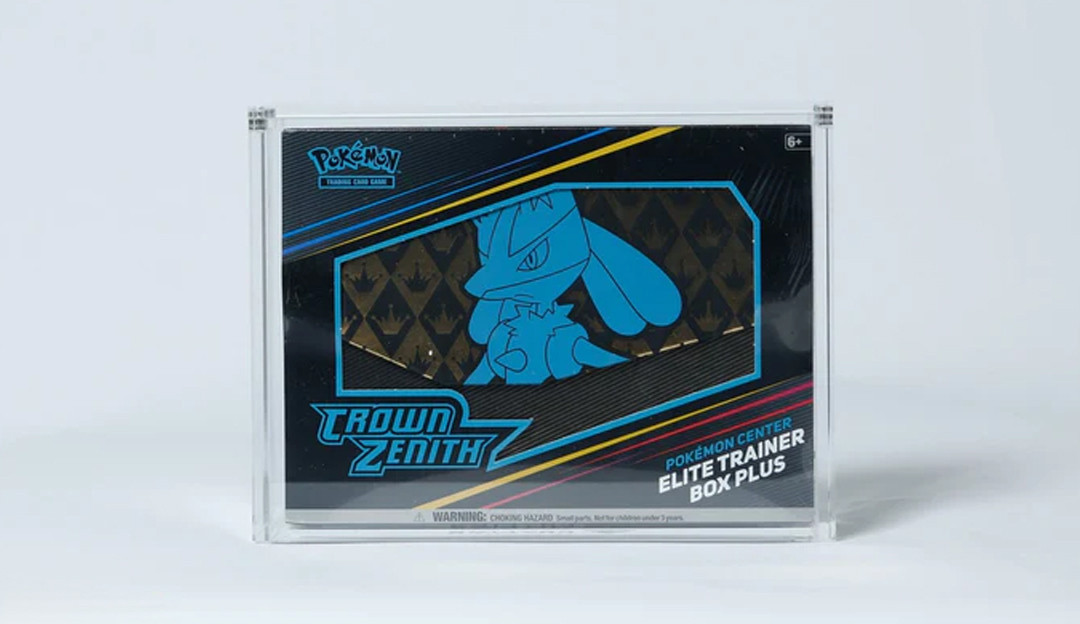
Acrylic Display Cases for Retail: Protecting Product While Driving Sales
An acrylic display case does two jobs at once for a retail store: it keeps high-value product visible but out of reach, and it makes that product look more valuable than it would loose on a shelf. Clear acrylic showcases are the standard fix for sealed booster boxes, Elite Trainer Boxes (ETBs), Ultra Premium Collections (UPCs) and graded slabs — items that walk out of a store easily and lose resale value fast once the seal is broken. GUARD TCG has manufactured acrylic display cases for game stores, distributors and brand owners since 2009, so this guide focuses on what actually works on a shop floor: placement, locking and wall-thickness choices, lighting, and how to buy at retail quantities.
What Is an Acrylic Display Case for Retail?
An acrylic display case is a transparent enclosure — usually crystal-clear cast PMMA (polymethyl methacrylate) — built to fit a specific product or product category. In TCG retail it is most often a fitted box for a sealed booster box, an ETB, a premium collection, or a graded card slab. Some units are tabletop cubes with a removable or hinged lid; others are screw-down security cases locked with a small key or a magnetic latch.
The material choice is deliberate. Acrylic transmits roughly 92% of visible light — comparable to glass — at about half the weight, and it will flex rather than shatter into shards when knocked off a counter. That combination of clarity, toughness and low weight is what makes it practical in a shop where product gets handled, moved for events, and rearranged weekly.
Why Retailers Use Acrylic Display Cases: The Core Benefits
- Shrink reduction. A locked or screw-down case removes the "grab and go" option for the most portable, most resellable items in the store. NRF's National Retail Security Survey reported that the average retail shrink rate rose to 1.6% of sales in FY2022 from 1.4% in FY2021 — about $112.1 billion in losses across US retail — and display security is one of the cheapest levers a small store has against it.
- Damage protection. Sealed boxes dent, corners crush and printed film scuffs. A rigid case absorbs the fingerprints, shelf wear and accidental drops that turn a mint sealed box into a "seconds" listing.
- Perceived value. A product behind clean acrylic reads as premium and collectible. The same ETB on an open shelf reads as inventory.
- Merchandising flexibility. Cases can be angled, stacked or raised on risers, so a store can build a feature display without drilling shelving.
- Branding surface. Custom-printed edge panels and inserts turn a generic case into shelf advertising for the store or for an OEM brand.
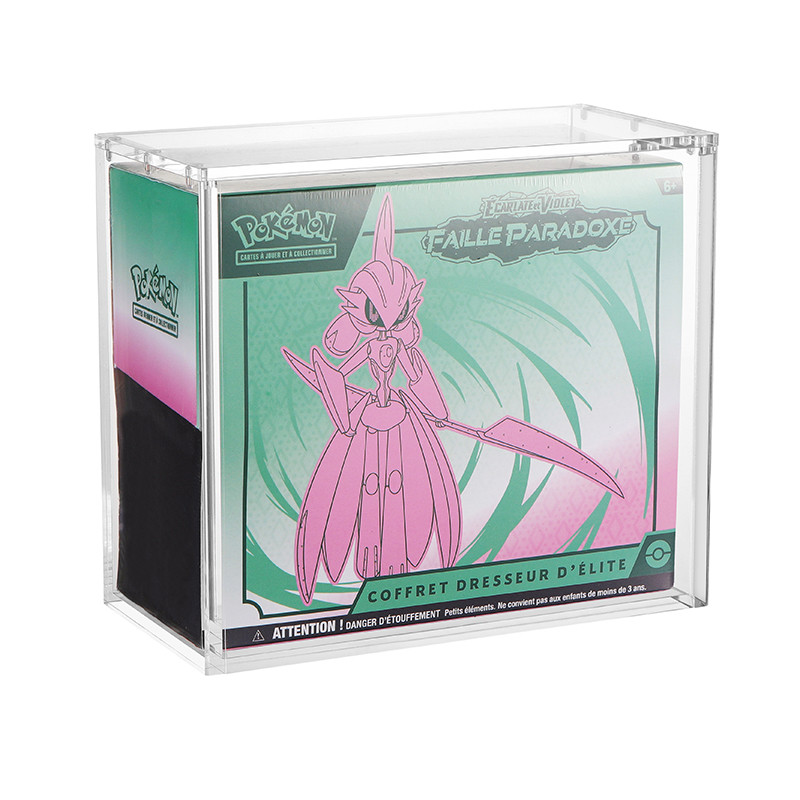
Fitted booster box cases keep sealed product visible on the counter while blocking casual handling — the most common retail use of acrylic display cases.
Acrylic vs. Glass vs. Corrugated Cardboard
| Feature | Acrylic Case | Glass Case | Cardboard Display |
|---|---|---|---|
| Optical clarity | ~92% light transmission, crystal clear | ~90-92%, excellent but heavier | Opaque on three sides |
| Impact behaviour | Flexes; cracks but does not shatter into shards | Shatters; safety risk on a shop floor | Crushes under load |
| Weight | Roughly half the weight of glass for the same thickness | Heavy; needs sturdier shelving | Very light |
| Security options | Screw-down panels, key locks, magnetic latches | Lockable, but glass panels are smashable | None |
| UV protection | Available; UV-resistant grades block the majority of UV | Standard glass passes most UV | No |
| Custom fit / OEM | Laser-cut and thermoformed to product dimensions; easy to customise | Costly custom tooling | Print-run sizes only |
| Shipping cost | Lower breakage rate and lighter freight | High breakage and freight cost | Lowest |
| Cleaning | Damp microfibre cloth only; avoid alcohol and paper towels | Any glass cleaner | Replace when worn |
Where Acrylic Display Cases Go: Counter, Shelf and Window
The same case performs differently depending on where it sits, so it is worth planning placement before ordering.
- Checkout counter. The highest-return position. Cases here hold the top few high-value sealed items or the shop's best graded slab, and they convert while the customer's wallet is already open.
- Shelf and riser. Cases on mid-height shelving protect inventory from browsing hands and let staff stagger heights so a sealed display is visible above the row in front.
- Window and feature wall. A window case works as signage: it advertises that the store carries premium sealed product. Keep UV-resistant grades here, since direct sun fades packaging print and can damage slabs over time.
- Event and tournament benches. A portable display case doubles as a safe place for tournament prizes and prize-wall slabs during play.

Counter-height cases sized to a specific sealed product look intentional rather than improvised — useful when the display itself has to sell the box.
Theft Deterrence and Damage Protection by Design
Not every case is a security case, and the difference comes down to three details.
Wall thickness. Retail acrylic cases are typically built from 2-3 mm sheet for display-only units and 3-5 mm for counters that see heavy handling. Thicker sheet resists flexing when a case is picked up, which keeps hinge and screw holes tight over years of use.
Closure type. A slip-on lid is fine for display. A screw-down or key-locked lid is what actually stops a determined shoplifter, because the case cannot simply be tipped and shaken open. Magnetic latches sit in between — quick for staff to open, inconvenient for anyone else.
Panel assembly. Solvent-bonded or mechanically fastened edges with no exposed gap prevent fingers and tools from being worked between panels. This is also where cheap cases fail: a visible seam is both a security weakness and an eventual crack start point.
Perceived Value: Lighting, Risers and Signage
Protection is half the job; the other half is making the case sell.
- Light from above and behind. A small LED strip above the case, or a backlit riser, makes sealed holo packaging and slab labels read sharply. Avoid hot spots directly on the acrylic — they show every smudge.
- Risers and angles. Tilting a product 10-15 degrees toward the customer makes the front panel readable without the customer touching the case.
- Price and story labels. A small card with the set name, the grade or the year turns a display box into a talking point. Graded slabs benefit most: the grade is the selling point, so make the label visible.
- Consistency. Using the same case family across the store reads as a curated collection rather than leftover packaging. This is one reason stores order cases in matched sets rather than one at a time.
Who Should Use Acrylic Display Cases?
Local game stores and hobby shops get the clearest return, because they carry portable, high-resale sealed product and slabs. Distributors and wholesalers use them for trade-show and warehouse-showroom displays where a product has to look intact. Brand owners and OEM buyers use custom cases as retail packaging — a printed acrylic case can replace a tuck box for premium SKUs. Individual collectors often buy a single case to store and display one centrepiece item, typically a sealed vintage box or a high-grade slab.

Oversized premium collections need a case dimensioned to that exact product — a case that rattles or presses on the seal defeats the point.
How to Choose the Best Retail Display Case
Work through these parameters before requesting quotes:
- Exact product dimensions in millimetres, plus 3-5 mm clearance so the product slides in without pressure on corners.
- Sheet thickness — 2-3 mm for display, 3-5 mm for security and counter use.
- Closure — slip lid, magnetic latch, screw-down, or key lock.
- UV option — specify UV-resistant sheet for window displays and long-term storage.
- Custom printing — edge panels, base inserts, logo etching.
- MOQ and lead time — GUARD TCG runs a standard MOQ of 100 pieces on our standard cases, with OEM/ODM programs for custom tooling; production batches are fully inspected before packing.
- Freight — express via DHL, FedEx or UPS lands in roughly 5-12 days, while sea freight runs about 25-35 days for larger orders.
As a rough industry estimate, a display-only acrylic case costs a fraction of the product inside it, which is why the payback usually comes down to a single prevented loss rather than a long calculation. Full range: display cases and showcase boxes.
Best Practices for Maintaining Acrylic Displays
- Wipe with a soft microfibre cloth and lukewarm water; dry with a second cloth to avoid water marks.
- Never use alcohol, ammonia-based glass cleaner, acetone or abrasive pads — they cloud the surface permanently.
- Dust the inside before closing a case, and handle by the edges when fitting panels.
- Keep window displays out of direct sun; use UV-resistant grades if sun exposure is unavoidable.
- Check screw fixings and latches quarterly, and re-tighten rather than over-tightening a single screw.
- Store spare cases flat and wrapped, not stacked under other stock.

Graded slabs are the classic retail case product: high resale value, easy to pocket, and far more convincing behind clear acrylic.
About GUARD TCG
GUARD TCG is a trading card accessories manufacturer established in 2009, producing more than 300 million pieces per year for customers in over 70 countries. We work with more than 10,000 customers and 500+ distributors, and we run both OEM and ODM programs alongside our standard range. Every production batch is fully inspected before packing, and we ship worldwide by express and sea freight. Learn more on our about page or contact us for retail and wholesale enquiries.
FAQ
Q1: Do acrylic display cases scratch easily?
Acrylic is softer than glass, so it can pick up fine scratches if it is wiped with paper towels, dry cloths or abrasive cleaners. Use a damp microfibre cloth and lukewarm water, dry with a second clean cloth, and dust rather than scrub. Cases handled this way stay clear for years, and scratches on display-only units can usually be polished out.
Q2: Are acrylic cases strong enough for a busy shop counter?
Yes, provided you choose thickness to match the traffic. For a counter that is picked up and moved daily, specify 3-5 mm sheet and a screwed or locked closure. Thin 2 mm cases are intended for static shelf display, not constant handling.
Q3: Acrylic or glass for a retail display?
Acrylic is the practical choice for most stores: lighter, less likely to shatter, cheaper to ship, easier to customise to a product's exact dimensions, and available in UV-resistant grades. Glass has slightly better scratch resistance and a more rigid look, but its breakage and freight costs are hard to justify in a shop where displays move.
Q4: What is the minimum order for custom acrylic display cases?
Standard cases start at a MOQ of 100 pieces, while fully custom OEM/ODM tooling is quoted case by case depending on dimensions and print requirements. Retailers typically begin with a mixed order covering their top three to five sealed SKUs. See more guides in our blog.
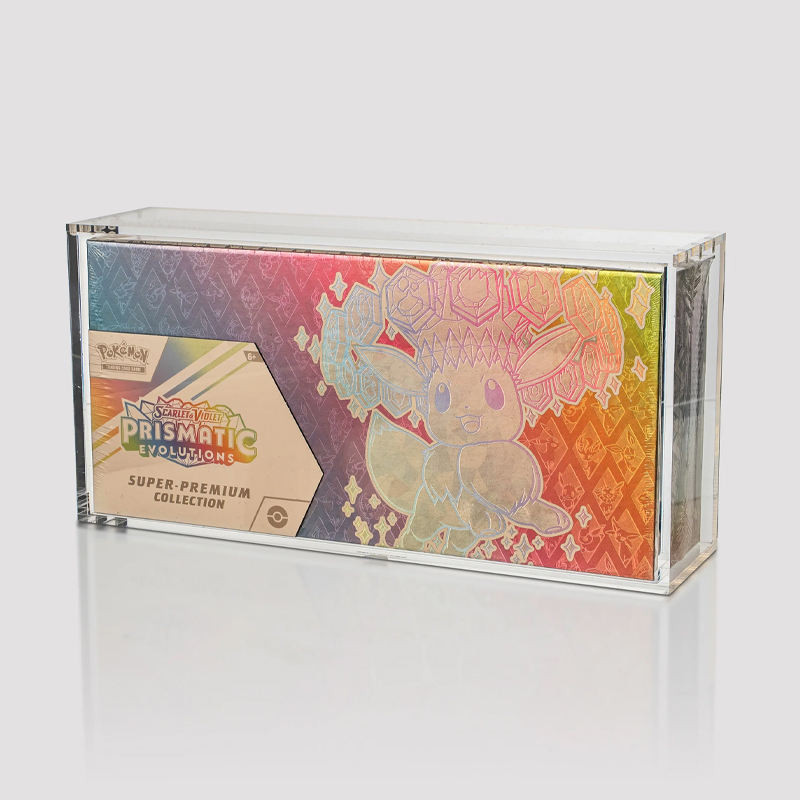
UV-resistant ETB cases suit window and sunlit shelf positions, where standard acrylic would let packaged print fade over a season.
Conclusion
Acrylic display cases protect retail product and sell it at the same time: the clear panel keeps sealed booster boxes, ETBs, premium collections and graded slabs visible and desirable, while the right wall thickness and closure remove the easy opportunity to walk off with them. Plan placement first — counter, shelf or window — then specify sheet thickness, closure type and a UV option to match that spot. At roughly 92% light transmission, up to half the weight of glass and the ability to flex instead of shatter, acrylic is usually the practical answer for a shop floor. A single prevented loss on a high-value sealed box or slab typically covers the cost of the case holding it.