How to Display Booster Packs in Retail Stores to Boost Sales
- Share
- publisher
- GUARD TCG Team
- Issue Time
- Sep 19,2026
Summary
Booster pack sales live or die on display. This guide covers the three principles of retail pack merchandising (visible, touchable, impulse-friendly), how to run an acrylic dispenser (capacity, position, restocking), checkout counter impulse zone design, lighting and signage, a dispenser vs. screw-down case vs. open tray comparison, how to choose a pack dispenser, and a two-week before-and-after method for measuring whether the display actually lifted packs sold per transaction.
How to Display Booster Packs in Retail Stores to Boost Sales
Booster pack display works on three principles: make packs visible in a clear acrylic dispenser at eye level, make them touchable in an open self-serve tray, and make them impulse-friendly at the checkout counter. Get those three right and loose packs stop being an afterthought in a drawer and start selling every time a customer walks in. GUARD TCG has supplied retail display hardware to game stores and distributors since 2009, and this guide covers the dispenser method, counter placement, lighting and signage, plus how to measure whether a display change actually moved your numbers.
What Is a Booster Pack Display — and Why Does Placement Sell Packs?
A booster pack display is any fixture that holds loose packs so customers can see and take them without asking staff: an acrylic dispenser, a tiered counter tray, a screw-down case for premium or sealed packs, or a wall-mounted rack. The fixture itself is not decoration. It changes the pack from a product a customer has to think about into a product they simply pick up while their wallet is already open.
That distinction matters because loose packs are one of the highest-frequency, lowest-consideration purchases in a game store. A player who walks in for a Friday Night Magic entry does not plan to buy a pack, but a $5-$7 pack sitting in their line of sight at the counter is an easy yes. The display is what converts that easy yes into a transaction.

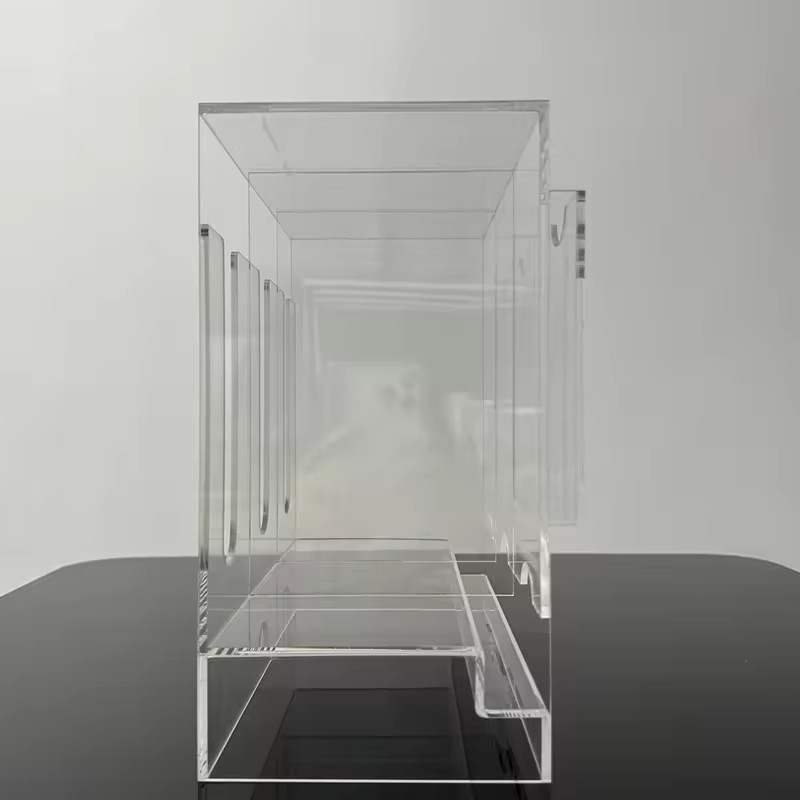
A clear acrylic dispenser keeps loose booster packs upright, organized and impossible to ignore — the single most common fixture in stores that sell packs well.
Why Display Drives Pack Sales: The Core Benefits
- Higher impulse conversion. Packs placed at the point of purchase catch customers in the moment of paying, when resistance to a small add-on purchase is lowest — a widely reported pattern in retail merchandising research.
- More packs per transaction. An open tray lets a customer grab two or three packs instead of asking for one, which lifts units per basket without any discount.
- Better perceived value. A tidy acrylic case signals that the product is worth protecting, which helps justify premium pricing on collector packs and sealed bundles.
- Less shrinkage and damage. Packs in a dedicated display are handled less casually than packs in a loose box, so fewer corners get bent and fewer packs go missing.
- Faster restocking. A dispenser with a defined capacity makes it obvious at a glance when you are low, so staff reorder before a stock-out on release weekend.
- Free merchandising space. The top of a dispenser or case becomes a shelf for price cards, set names and new-release signage at zero extra cost.
The Dispenser Method: Capacity, Position and Restocking
The dispenser is the workhorse fixture of pack retailing. Used well, it does three jobs at once: it presents packs, it gates stock so customers take one at a time, and it tells you when to reorder.
Capacity. Match the dispenser to how fast the product moves. A high-traffic store wants a dispenser that holds a full box or more so staff are not refilling it mid-event; a smaller store is better served by a compact counter unit that turns over fully every week and never holds dead stock. Whichever you choose, keep one box of backup stock within arm's reach behind the counter.
Position. Eye level beats floor level and beats a far wall. The dispenser should sit where a queue forms, so a customer waiting to pay is literally staring at packs. If your counter is a straight run, put the dispenser at the start of the queue rather than beside the register — customers pick up on the way past, not after they have paid.
Restocking. Refill to full, not to "good enough." A dispenser that looks half-empty reads as picked-over and stale, and the last few packs in a display sell far slower than a full one. Set a simple rule: refill whenever the display drops below two-thirds full, and log which set moved fastest that week.

A dedicated pack case is the retail version of a shop window: it presents the current set, sets the price expectation and keeps the next release visually separated from the discount bin.
Designing the Checkout Counter Impulse Zone
The checkout counter is the highest-value real estate in a game store, and packs belong in it. Build the zone in three layers so the customer's eye moves from the register outward.
- Layer 1 — the register line: the main dispenser with the current set, priced clearly, positioned where the queue stands. This is the volume driver.
- Layer 2 — the add-on shelf: sleeves, toploaders, dice and deck boxes next to the packs. A customer buying a pack is already thinking about protecting or playing what they open, which makes these the highest attach-rate items in the store.
- Layer 3 — the premium eye-catcher: a screw-down acrylic case holding a sealed bundle, a premium collector pack or a high-value single. It is not expected to sell often; it exists to raise the perceived ceiling of the whole zone.
Keep the zone uncluttered. Every extra fixture competes for attention, and a counter buried under product converts worse than a clean one with three clear price points.

A bundle case turns six individual packs into one higher-ticket purchase — useful for gift buyers and for clearing a set the week before a new release lands.
Lighting, Signage and Price Tags
Two packs of the same product sell at very different rates depending on how they are lit and labeled.
- Light the product, not the room. A small directional LED or spot on the dispenser makes foil and art pop far better than overhead store lighting. Avoid direct sunlight and hot halogen bulbs, which fade print and can warp cards inside the pack over time.
- Name the set and the price. A large, readable price card next to the dispenser removes the single biggest hesitation — the customer not knowing what it costs. Price every tier, not just the cheapest.
- Flag the new release. A simple "New Set" tag near the current expansion captures collectors who are chasing the newest cards and gives regulars a reason to buy an extra pack.
- Use one clear hierarchy. Set name largest, price second, any promotion third. Competing fonts and stickers make a counter look messy and slow the buying decision.
Dispenser vs. Screw-Down Case vs. Open Tray
Different fixtures suit different products, volumes and risk levels. The table below compares the three you will see most often in game stores.
| Feature | Acrylic Dispenser | Screw-Down Case | Open Counter Tray |
|---|---|---|---|
| Best for | Everyday loose packs at high traffic | Sealed bundles and premium packs | Cheap singles, promos, impulse bin |
| Visibility | Very high — clear front, upright stack | High — clean showcase presentation | Medium — easily looks cluttered |
| Security / theft resistance | Medium — one-pack-at-a-time gate | High — screw-down or locked closure | Low — open access |
| Units held | High — a full box or more | Low — one or a few items | Medium, but messy when full |
| Restock effort | Low — drop in from the top | Higher — unscrew to access | Very low |
| Damage protection | Good — packs held upright | Excellent — rigid enclosure | Poor — corners get bent |
| Typical counter footprint | Small to medium, vertical | Small | Large, horizontal |
| Best role | Volume impulse engine | Premium value showcase | Clearance and entry price point |

A screw-down case covers the two highest-risk lines on a game store counter at once: premium sealed packs and anything a customer might walk off with.
How to Choose the Right Booster Pack Dispenser
Before you buy, measure the space and answer five questions.
- What pack formats do you sell? Standard TCG packs, Japanese-size packs and oversized or sealed bundles are different dimensions. If you stock more than one format, choose a modular display or buy two units rather than forcing everything into one tray.
- How many units per week? Match capacity to turnover. High-volume stores want deep capacity and a discreet lock; hobby stores with slower turnover want a smaller display that never sits half-empty.
- Where will it physically sit? Measure the counter run, the queue depth and the register clearance before ordering. A dispenser that blocks the card reader is worse than no dispenser.
- How much handling will it take? Thicker acrylic walls resist scratching and crazing better over years of daily use; thin walls look tired within a season.
- Can it match a format you already use? If you already run acrylic cases for booster boxes and ETBs, choose a matching finish so the counter reads as one deliberate display system rather than a yard sale.
This is also where buying factory-direct pays off. Standard acrylic display lines start at a low minimum order quantity — around 100 pieces — so a store can test a fixture and reorder only what works, rather than committing to a container of one design. See the full product range for pack dispensers, cases and counter hardware.
Measuring Whether the Display Actually Boosted Sales
A merchandising change you cannot measure is a guess. Run a simple before-and-after on a single fixture and one product line to see whether the new display earns its counter space.
- Baseline two weeks. Record packs sold per day, average packs per transaction and total pack revenue with your current setup.
- Change one variable. Move packs into a visible dispenser at the counter without changing price, stock depth or promotion.
- Run two more weeks. Track the same three numbers through two full event cycles, including a weekend, so one busy FNM night does not distort the result.
- Compare units, not just revenue. Revenue can rise because you sold a more expensive set. Units per transaction is the honest measure of whether display changed behavior.
- Keep what works, move what does not. If a fixture underperforms, relocate it before you replace it — position usually explains more of the difference than the fixture itself.
Treat the numbers as an industry-style estimate rather than a guarantee: your baseline will differ from another store's, but the direction of the change is what you are testing, not the exact percentage.
Best Practices for Booster Pack Merchandising
- Keep the current set front and center. Rotate older sets to a lower tier or the clearance bin so the newest release owns the eye-level position.
- Price every tier visibly. Hiding the price on premium packs slows those sales the most.
- Pair packs with protection. Packs, sleeves and toploaders belong in the same zone — a customer opening a pack immediately wants somewhere to put what they pull.
- Refill before events, not during. Top up the dispenser before the tournament starts so no customer sees a half-empty display at peak traffic.
- Protect sealed value properly. For older or high-value sealed packs, use rigid display rather than an open tray. According to PSA's submission guidance collectors treat sealed and graded product as assets, and your counter should visibly protect them the same way.
- Keep one clean price point per tier. A confusing mix of stickers at the register is the fastest way to turn an impulse buy into a question.
Common Display Mistakes That Cost You Pack Sales
Three errors show up in stores of every size. First, packs kept behind the register or under the counter, where they are invisible until a customer asks — this removes the entire impulse moment. Second, displays left half-empty or stocked with older sets the crowd has already opened, which teaches regulars to ignore the fixture. Third, mixing loose packs, premium cases and clearance stock in one pile, which blurs the price hierarchy and makes the whole counter look discounted. Fix those three and the display starts working while you serve the queue.

Format-specific cases matter: Japanese-size booster boxes and packs need their own dimensions, and a case that fits properly looks intentional instead of improvised.

Single-pack toploaders blur the line between display and protection — a way to present one premium pack as a gift-ready item on the counter.
About GUARD TCG
GUARD TCG has manufactured trading card protection, storage and display products since 2009, producing more than 300 million pieces a year for 10,000+ customers and 500+ distributors across 70+ countries. Our range includes acrylic booster pack dispensers and display cases, booster box and ETB cases, card sleeves, toploaders, binders, storage boxes and retail counter hardware for game stores, distributors and private-label brands. Standard display lines start at around 100 pieces MOQ, orders ship by DHL, FedEx or UPS in 5-12 days or by sea in 25-35 days, and every batch passes full inspection before it leaves the factory. Browse our full product range for wholesale pricing, read about our factory, or send an inquiry with your counter plan and target dimensions.
FAQ
Where is the best place to put a booster pack dispenser?
At the start of the checkout queue, at eye level, where a waiting customer naturally looks. It should be visible before the customer reaches the register, not hidden behind it, so the impulse decision happens while they are still standing in line.
How many booster packs should a counter display hold?
Match capacity to weekly turnover. Fast stores benefit from a dispenser holding a full box or more so staff are not refilling during events; slower stores should choose a smaller unit that empties within the week and never looks half-full or stale.
Do I need a locked case for booster packs?
Not for everyday standard packs — a normal dispenser is enough. Use a screw-down or lockable acrylic case for premium, older or high-value sealed product, where both theft and handling damage are real risks.
Does displaying packs actually increase sales?
Position and visibility are among the strongest levers on small impulse purchases, which is why packs at the point of purchase consistently outperform packs kept behind the counter. The honest way to know for your store is a two-week before-and-after test on packs sold per transaction.
How do I stop packs from fading or warping in a display?
Keep the display out of direct sunlight and away from hot bulbs or heat vents. Use LED lighting, avoid halogen near product, and keep the counter area at a stable room temperature so foil and print stay crisp over time.
Can I order custom or branded displays for my store?
Yes. OEM and ODM programs cover custom-printed sleeves, branded display cases and bespoke acrylic fixtures, with minimum order quantities that depend on tooling and printing. Standard display lines without custom branding start much lower, around 100 pieces.
Conclusion
Boosting booster pack sales is mostly a display problem, not a pricing problem. Put packs in a clear acrylic dispenser at the start of the checkout queue and keep it full (visible, touchable, impulse-friendly); build a three-layer counter zone with packs, protection accessories and one premium eye-catcher; light and price every tier clearly; and measure the change over two full weeks before you decide it worked. Stores that get this right sell more packs per transaction without touching the price, protect premium sealed product in proper cases, and turn passive counter space into their most reliable impulse revenue. Back to GUARD TCG home.