Shelf-Ready TCG Merchandising: How Layout Affects Accessory Sales
- Share
- publisher
- GUARD TCG Team
- Issue Time
- Sep 22,2026
Summary
TCG merchandising is layout work: arrange accessories by price tier and use case, put the highest-margin items in the golden zone at eye level (roughly 120-150 cm), cross-merchandise sleeves and toploaders beside booster packs, showcase sealed and graded stock in acrylic cases, and test changes against 30 days of sales data. Includes a three-tier zone plan, a fixture comparison table, a 30-day review method, and the layout mistakes that suppress accessory sales.
Shelf-Ready TCG Merchandising: How Layout Affects Accessory Sales
TCG merchandising works when accessories are arranged by price tier and use case — entry, upgrade, and premium zones — with the highest-margin items placed in the "golden zone" at eye level (roughly 120–150 cm), sleeves and toploaders cross-merchandised directly beside booster packs, and every arrangement reviewed against 30 days of sales data. Layout is not decoration; it is the cheapest sales lever a card shop owns. The sections below explain the retail research behind that answer and show how to rebuild a shelf plan for a 20–60 m² game store.
What Is Shelf-Ready TCG Merchandising?
Shelf-ready merchandising means designing fixtures, sightlines, price tags, and product adjacency so that accessories sell themselves without a staff member explaining them. For a card shop, that covers four decisions: which products sit at eye level, which products sit next to which, how much shelf space each family gets (its "facings"), and how sealed or high-value product is displayed without blocking the view. All four decisions are about layout — the physical arrangement of product — long before they are about price.
Shelf-ready also implies that a product can go from delivery carton to shelf with no repacking. Accessories such as sleeves, toploaders, deck boxes, and acrylic cases arrive in display-ready cartons with printed branding and barcodes, which shortens restocking time and keeps facings consistent between shipments.
Why Layout Drives Accessory Sales: The Retail Psychology
Industry research consistently shows that most buying decisions are made inside the store, not before entering it. POPAI's Mass Merchant Shopper Engagement Study, a widely cited benchmark in retail planning, found that roughly three-quarters of purchase decisions are made in-store. If three out of four decisions happen at the shelf, then the shelf itself is the sales tool — and accessories, which are low-ticket and easy to justify, benefit most from that effect.
- Decompression zone: the first 1.5–5 m inside the entrance is where shoppers orient themselves rather than shop. Avoid giving that strip to high-margin accessories.
- Sightline hierarchy: shoppers scan eye level first, then hands, then floor. Placement order should follow margin order.
- Dwell time: tournament nights keep players in the shop for hours. Impulse accessories placed near the play area convert that idle time into add-on sales.
- Attach rate: cross-merchandising — putting the protector beside the protected product — raises units per transaction far more reliably than discounting.
- Decision fatigue: too many facings of similar SKUs slows choice. Fewer, clearer options sell faster than a wall of near-identical sleeves.
The Golden Zone: Eye-Level Shelf Height Explained
The golden zone — sometimes called the strike zone — is the shelf band between roughly 120 cm and 150 cm from the floor, where a standing adult's gaze naturally rests. Just below it, the hand-reach band (roughly 75–120 cm) is almost as strong because it requires no bending or stretching. Retail convention treats the golden zone as the most valuable real estate on the fixture; industry estimates commonly place the sales multiple of eye-level product at around twice that of the same item at floor level (industry estimate).
For a card shop, the golden zone should hold repeat-purchase, high-margin accessories: penny sleeves, perfect-fit inner sleeves, 35PT toploaders, one-touch magnetic holders, and slab bumpers. The hand-reach band suits binders, deck boxes, and playmats. The floor is for bulk refills and low-margin volume goods, and the top band above eye level is best used for display pieces or slow-moving stock that customers rarely grab unassisted.

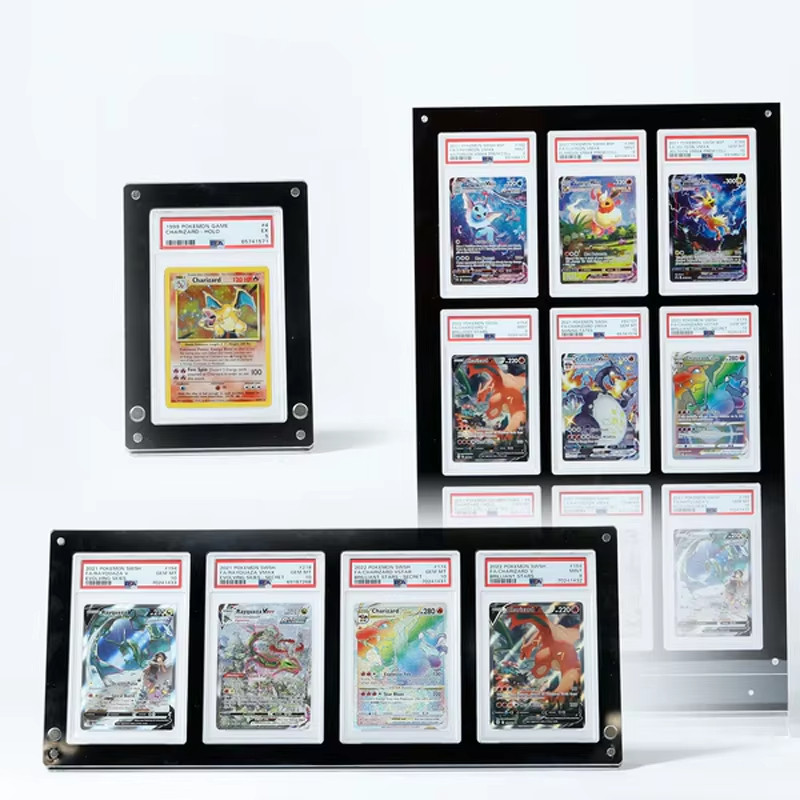
A screw-down acrylic display case keeps premium graded stock visible at eye level while protecting it — the top band of a fixture can carry real product instead of empty space.
Zone-Based Layout: Entry, Upgrade, and Premium Tiers
The practical way to apply the golden-zone rule is to split the accessory wall into three price tiers, each with its own job. This keeps customers moving from a low-risk first purchase toward a higher-value basket instead of confronting them with the most expensive item first.
- Entry zone (low price, high frequency): penny sleeves, single toploaders, dice, inner sleeves. Purpose: capture a first, almost automatic purchase.
- Upgrade zone (mid price, planned purchase): 9-pocket and 12-pocket binders, toploader binders, deck boxes, playmats. Purpose: upgrade the casual buyer into an organising collector.
- Premium zone (high price, deliberate purchase): acrylic display cases, lockable storage, graded-card cases. Purpose: anchor margin and signal that the shop serves serious collectors.
Place the entry zone nearest the entrance-to-sales-floor path (but past the decompression strip), the upgrade zone across the main walking line, and the premium zone where a customer can stop, compare, and be helped — usually near the counter or a lit wall.
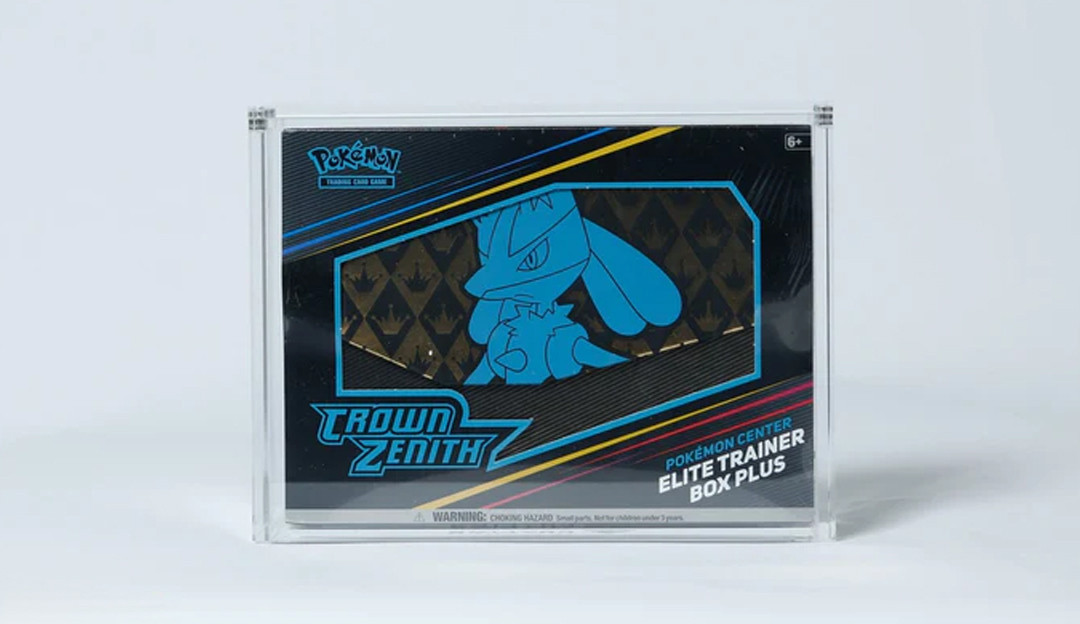
Clear acrylic booster box cases work as the premium anchor of a zone: they protect sealed product and let the artwork do the selling from across the room.
Cross-Merchandising: Sleeves Next to Booster Packs
Cross-merchandising is the single highest-return layout change in most card shops. The rule is simple: the accessory that protects a product should sit within one metre of that product. A customer who has just picked up a booster pack or a single is in the exact moment where a sleeve or toploader solves an immediate problem.
- Sleeves and penny sleeves directly beside booster packs and the singles case.
- Toploaders and card savers beside the singles counter, where the "I need to protect this" moment happens.
- Binders and storage boxes beside the set-building or bulk-box area.
- Acrylic display cases and graded storage beside the graded-card showcase.
- Deck boxes and playmats beside the tournament sign-up desk.

Keeping protection cases next to the sealed product they protect turns a browsing pass into a paired purchase.
Open Shelf vs. Screw-Down Acrylic Case vs. Behind-Glass Counter Case
Layout is also a security decision. The three display formats below trade visibility, touch, and theft risk against each other, and most shops need all three in different parts of the floor.
| Feature | Open Shelf Display | Screw-Down Acrylic Case | Behind-Glass Counter Case |
|---|---|---|---|
| Customer can touch the product | Yes — highest impulse effect | No — visible only | Only with staff assistance |
| Theft protection | Low | High (screw-down lid) | Highest (locked / watched) |
| Dust and handling protection | Low | High, fully enclosed | High, but staff-handled |
| Best for | Sleeves, toploaders, bulk refills | Graded cards, sealed boxes, UPCs | High-value singles and grails |
| Sales effect | Strong on low-ticket repeats | Strong on premium anchoring | Weak on impulse, strong on trust |
| Restocking effort | Lowest | Moderate — unscrew and reseat | Highest — staff mediation |
| Where it belongs in the shop | Golden zone and hand-reach band | Premium zone / lit wall | Counter and singles area |

A screw-down case removes the trade-off between showing a graded card and keeping it safe.
How to Choose Shelf-Ready Fixtures and Display Cases
Measure first, then buy. Note the exact usable width, depth, and vertical clearances of each fixture, decide which zone it serves, then match the fixture to that zone rather than to a catalogue photo.
- Zone fit: open trays and tiered risers for entry and upgrade zones; enclosed acrylic for the premium zone.
- UV protection: for anything displayed for months, prefer UV-filtering acrylic. GUARD TCG display materials are specified for high UV blocking to slow fading on printed card stock and box art.
- Modularity: choose stackable, same-footprint cases so a set change does not force a fixture change.
- Standard sizes: pick cases sized for 35PT toploaders, standard booster boxes, and 4–6 graded slabs, so stock always fits.
- Sourcing reality: GUARD TCG has manufactured card protection since 2009, producing over 300 million units a year for 70+ countries. Standard MOQ is 100 pieces, with DHL/FedEx/UPS delivery in 5–12 days or sea freight in 25–35 days, and every batch fully inspected in QC before shipment.
- Budget: spend the fixture budget on the golden zone and the premium anchor first — those two areas carry the margin.

Modular, uniform-footprint cases let a shop reset its retail display layout for each new set release without buying new fixtures.
Measuring Results: A 30-Day Layout Review
Layout changes should be treated as a test, not a taste decision. The method below is simple enough for a single-operator store and produces a defensible before-and-after number.
- Weeks 1–2 (baseline): record units per transaction, accessory share of revenue, and the top and bottom five accessory SKUs by units.
- Week 3 (change): move one variable only — for example, bring toploaders into the golden zone and place sleeves beside the pack box.
- Weeks 4–5 (measure): repeat the same counts. Compare accessory share and units per transaction against baseline.
- Monthly: cut facings for dead SKUs and give the space to items that turned.
- Seasonally: re-plan around new set releases, tournament seasons, and holiday gift traffic.
Common TCG Merchandising Mistakes to Avoid
- Shelving by supplier or invoice order instead of by customer zone and margin.
- Filling every square centimetre — no gaps means no visual entry point, and shoppers skim past dense walls.
- Leaving the decompression zone loaded with premium stock that nobody looks at.
- Hiding all protection products behind the counter, where buyers cannot solve their problem on impulse.
- Letting price tags fall out of alignment; unclear pricing suppresses accessory add-ons more than an average price level does.
- Never reviewing the shelf plan — a layout that worked in 2024 may be wrong for the 2026 mix.
About GUARD TCG
GUARD TCG is the card-protection brand of a Chinese manufacturing group founded in 2009, producing over 300 million protective products a year for more than 10,000 customers and 500+ distributors across 70+ countries. The factory runs OEM and ODM programs for sleeves, toploaders, binders, deck boxes, and acrylic display cases, with standard MOQ from 100 pieces, full batch-level QC inspection, and worldwide shipping via DHL, FedEx, and UPS in 5–12 days or sea freight in 25–35 days. The merchandising guidance in this article comes from supplying thousands of retail and distributor accounts, not from theory.
FAQ
Q1 How should a small card shop under 30 m² lay out accessories?
Use one wall as a single three-tier ladder: entry items in the hand-reach band, upgrade items at eye level, premium or sealed display on the top band, and bulk refills on the floor. Keep sleeves and toploaders within a metre of the pack and singles area, and put a single locked case at the counter for the highest-value stock.
Q2 Where exactly should sleeves and toploaders go?
Sleeves belong in the golden zone or hand-reach band and physically beside booster packs and the singles case. Toploaders work best beside the singles counter and beside grading-submission supplies, because that is where customers handle loose cards.
Q3 Do acrylic display cases actually increase sales?
They increase visibility and stop theft and handling damage, which supports full-price rather than discounted sales. Treat the shelf as a fixture with two jobs — protect the product and get it seen from across the room — and judge it on accessory share and units per transaction, not on the fixture cost alone.
Q4 How often should a shop reset its layout?
Review data monthly and re-plan the layout seasonally, plus a small reset with each major set release. Change one variable at a time so you can tell which move produced the result.
Conclusion
TCG merchandising is layout work: arrange accessories by price tier and use case, put the highest-margin items in the golden zone at eye level (roughly 120–150 cm), cross-merchandise protection products beside the products they protect, display sealed and graded stock in enclosed acrylic where it can still be seen, and test each change against 30 days of sales data. Three-quarters of purchase decisions happen in the store — which means the shelf, not the price list, is where accessory sales are won. Browse our card protection and display products to build the fixture plan, or contact us for retail and wholesale display solutions.