Tournament-Ready: Supplies Every TCG Event Organizer Needs
- Share
- publisher
- GUARD TCG Team
- Issue Time
- Sep 25,2026
Summary
A complete checklist of TCG tournament supplies every event organizer needs: playmats, spare uniform sleeves, deck boxes, dice and counters, match slips, toploaders, and branded prize display. Covers official rules compliance, what sells on site, and how to build a tournament-ready kit from GUARD TCG.
Tournament-Ready: Supplies Every TCG Event Organizer Needs
Tournament-ready supplies are the physical kit an organizer must have in place before the first round pairings go up: playmats, spare sleeves, deck boxes, dice and counters, match slips and life pads, deck storage for between rounds, and branded display props for prizes. Official organizer programs such as the Wizards Play Network and Pokémon Play! also require compliant, uniform sleeves and clean playmats so matches stay fair. Most organizers standardize on a fixed checklist sized per 8 to 32 players, then scale it as attendance grows. This guide covers the full checklist, the specifications that actually matter, and how to turn event supplies into on-site sales.
What Counts as TCG Tournament Supplies?
Tournament supplies fall into four functional zones: play surface, player equipment, administration, and prizes and display. Play surface covers playmats and table coverage. Player equipment covers sleeves, deck boxes, dice, counters, and tokens. Administration covers match slips, life pads, pens, pairings printouts, and results entry. Prizes and display covers promo cards, trophy or prize displays, and acrylic showcase props that make the prize wall feel worth playing for.
The mistake most new organizers make is treating only the player-facing items as "supplies" and forgetting administration and display. A tournament that runs smoothly but looks improvised loses players to the next store, because presentation signals competence before a single game is played.
Why Tournament-Ready Supplies Matter for Organizers
- Rules compliance: official rules require uniform, unmarked sleeves and clean play surfaces; a store that supplies spare sleeves and mats can fix a compliance problem in seconds instead of issuing a penalty.
- Faster rounds: spare sleeves, spare dice, and pre-printed match slips cut the dead time that stretches a five-round event into a six-hour night.
- Player retention: players judge an organizer on the small things, and a store that always has the right supplies becomes the default venue in its area.
- On-site revenue: the tournament crowd is the most captive accessory audience a store will ever have; the right shelf turns entry fees into accessory sales.
- Brand consistency: branded playmats, counters, and displays make the store and its sponsors visible all night.
- Damage control: spare boxes protect decks that would otherwise sit loose on a table between rounds, and spare holders protect the cards players bring to trade.

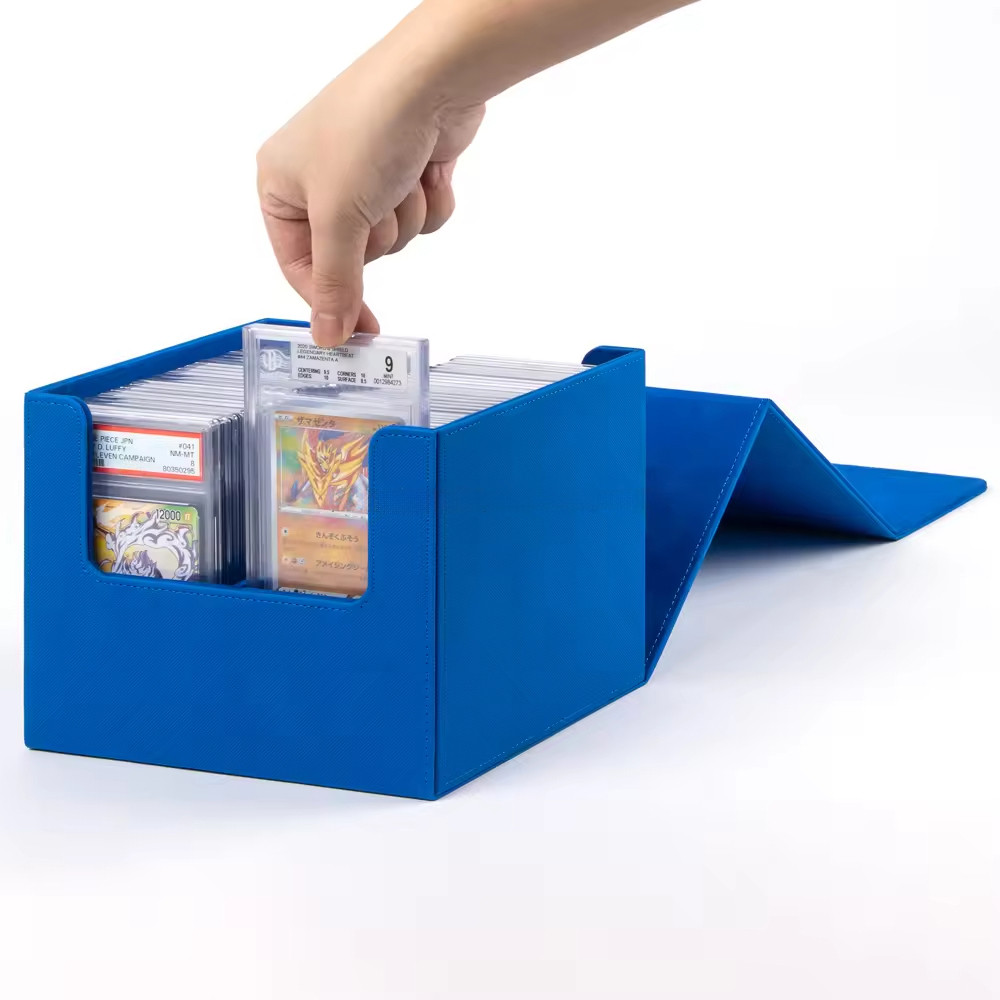
Deck storage is the quiet workhorse of an event: boxes keep competitors' decks flat, protected, and organized between rounds.
The Complete Tournament Supplies Checklist
Build the kit by zone, then set a quantity per player and a buffer for replacements. The list below is the one organizers come back to season after season.
- Play surface: one playmat per table minimum, plus spares; tablecloths or surface covers for overflow tables; a clean-mat box so mats stay flat rather than rolled and creased.
- Player equipment: spare packs of 100-count sleeves in the store's house colour, spare deck boxes (including a 100+ size for double-sleeved decks), dice and counter sets, and a shared token box.
- Administration: match slips or result slips per round, life pads, pens, a pairings board or screen, and a results-entry device with a backup battery.
- Trade and grading support: penny sleeves, rigid toploaders, and card savers for players buying, selling, or preparing submissions on site.
- Prizes and display: promo and prize stock, a prize wall with an acrylic display or signage, and stands so prizes sit at eye level.
- Logistics: a lockable carrying case for the prize kit, spare storage boxes, and a labelled bin for lost property.
Quantity planning is simpler than it looks: count one playmat per seat plus roughly ten percent spares, one spare sleeve pack per twenty players, and one spare deck box per ten. Re-check quantities after every event and restock the kit as a unit so it is never half-empty at the start of a night.
Official Rules Compliance: What the Specs Require
Different games phrase the rules differently, but the practical requirements are consistent across the major organizer programs, and reviewing an event's own policy document before the season is the right first step.
- Uniform sleeves: sleeves must be identical across a deck, unmarked, and in the same orientation for all cards in a deck, per the Magic Tournament Rules and comparable Pokémon and Yu-Gi-Oh! policies. Organizers should keep spare packs on hand so a single split sleeve can be replaced without a penalty.
- Clean playmats: art on playmats is fine, but organizers are expected to ensure mats and tables are clean and free of marks that could carry information.
- Card condition: card protectors used at competitive events should not allow a marked card to be distinguished, which is why fresh, uniform sleeves matter more at higher rules-enforcement levels.
- Sponsor and prize rules: user-supplied play aids such as counters must not replace required game components, so stores should provide official counters where a program mandates them.
The Wizards Play Network also supplies organizer resources such as event play aids, promo cards, and marketing kits to registered stores, which is why joining an official program is the fastest route to compliant, branded event material.

A spare sleeve pack is the cheapest insurance an organizer can carry: it turns a penalty situation into a thirty-second fix.
Organizer Kits vs. Loose Supplies vs. Player-Supplied Gear
The table below compares the three sourcing models organizers use, across the factors that decide what actually works on event night.
| Feature | Store-Provided Kit | Loose Accessories | Player-Supplied Gear |
|---|---|---|---|
| Who owns the cost | Store / organizer | Store / organizer | Player |
| Rules compliance risk | Low - spares always on hand | Medium - depends on what was bought | High - mixed sleeves and worn mats |
| Round speed impact | Fastest - no waiting on fixes | Moderate | Slowest - players hunt for items |
| Upfront investment | Higher - one planned purchase | Lower - buy as needed | None for the store |
| Recoupable revenue | High - kit doubles as shelf stock | High - same SKUs, no kit moat | Low - spend goes elsewhere |
| Branding potential | High - custom mats and counters | Low - generic packaging | None |
| Best for | Registered stores running weekly events | Clubs testing whether events work | Casual kitchen-table groups only |
| Repeat effort | Low - restock as a single unit | High - track each SKU separately | None |
How to Choose the Right Supplies for Your Events
Match the kit to the formats and rules-enforcement level you actually run, not to the biggest tournament you might one day host.
- Size the playmat order to your table count: count seats, add ten percent spares, and choose a mat size that fits the table without overhanging. Mats should lie flat, so a supplier that ships them flat or in rigid tubes is worth choosing.
- Standardize sleeves: pick one house colour and one thickness for all spare packs, so replacements always match. Consistency also makes it easy to spot a genuinely marked card.
- Choose deck boxes that match your format: a 100+ convertible box suits Commander and double-sleeved decks, while slimmer flip boxes suit standard 60-card play; stocking both covers the room.
- Add rigid protection for trade and grading: toploaders and card savers cost little and prevent the on-site damage that ruins a trade or a submission.
- Verify durability before scaling: order a sample batch, run it through a few events, and only then commit to volume; standard MOQ from 100 pieces makes that test inexpensive.

Sleeves are the one supply every attendee touches, so a range that spans matte, clear, and holographic finishes covers both competitors and collectors.
On-Site Sales: What Actually Sells at Events
A tournament is a captive market, but only if the right items are within arm's reach of the play area. The products that reliably sell during an event are the ones that solve a problem the player just discovered.
- Spare sleeves: the single highest-velocity accessory at any event, because a sleeve splitting mid-round is the most common in-play problem.
- Deck boxes and cases: players who arrived with a loose deck buy storage the moment they see a friend's boxed deck.
- Dice and counters: cheap add-ons at the counter that frequently ride along with a sleeve purchase.
- Toploaders and penny sleeves: sold to the trade crowd, who protect anything they buy on site before it leaves the building.
- Storage and carrying cases: the natural upgrade at the end of a long event, when a player wants to leave with everything organized.
Merchandise the shelf as a "tournament survival zone" near the sign-up desk rather than scattering items across the store, and keep the top three sellers at counter height where staff can hand them over during registration.

Low-cost deck boxes are ideal impulse stock: stackable, easy to price, and useful to almost everyone in the room.
Sponsorship and Brand Exposure Through Custom Supplies
Supplies are also marketing inventory. A custom playmat, a branded counter set, or a printed deck box puts the store or a sponsor in front of every player for the entire event, which is exposure no banner can match.
- Custom playmats: the highest-visibility item; a store mat with its logo and event schedule becomes a walking advertisement every time a player uses it elsewhere.
- Branded sleeves: store-brand sleeves in a signature colour build recognition and create a repeat-purchase line.
- Custom counters and tokens: low-cost, high-perceived-value items that sponsors are usually happy to fund.
- Prize display props: an acrylic showcase for the trophy or the chase card turns a prize table into a photo opportunity that players share online.
Because these are made through OEM and ODM programs with standard MOQ from 100 pieces, a store can start with a single branded mat run and expand to sleeves and counters as the event series grows.

Convertible cases that hold a full double-sleeved deck give branded event kits a practical anchor item, not just a branded one.
Common Organizer Mistakes to Avoid
- Buying supplies event by event instead of building one kit that is restocked as a unit.
- Standardizing on one deck box size that fails half the room's decks, especially double-sleeved Commander builds.
- Skipping spare sleeves, then penalizing players for damage the store could have fixed.
- Putting event stock in a back room so the captive audience never sees it.
- Choosing supplies on price alone and living with splitting sleeves, brittle boxes, or mats that will not lie flat.
- Branding nothing, so the event leaves no trace in the local player community after the last round.
Every one of these is cheaper to prevent than to fix, and all six trace back to treating supplies as an expense rather than as event infrastructure that also happens to be sellable stock.
About GUARD TCG
GUARD TCG is the card-protection brand of a Chinese manufacturing group founded in 2009, producing more than 300 million protective products a year for over 10,000 customers and 500+ distributors across 70+ countries. The factory runs OEM and ODM programs for sleeves, toploaders, deck boxes, binders, and acrylic display cases, with standard MOQ from 100 pieces, full batch-level QC inspection, and worldwide shipping via DHL, FedEx, and UPS in 5 to 12 days or sea freight in 25 to 35 days. Product specifications such as 50-micron sleeve film, 35PT rigid toploaders, and 92 to 99% UV-blocking display materials come directly from our production lines. The organizer guidance in this article reflects what we see working among the stores and distributors we supply, not theory.
FAQ
Q1 How many playmats do I need to run an event?
Count one playmat per seat plus roughly ten percent spares to cover damage, stains, and the occasional player who forgets theirs. A 32-seat event therefore needs around 35 mats, and a store running multiple events a week should keep a dedicated flat storage box so mats stay clean and lie flat rather than curling at the corners.
Q2 Are players required to use the organizer's sleeves?
No. Players normally bring their own sleeves, but official rules require them to be uniform, unmarked, and oriented the same way across the deck. The organizer's job is to keep compliant spare packs on hand so a damaged sleeve can be replaced on the spot, keeping the deck legal without a penalty.
Q3 What is the most profitable thing to sell at a tournament?
Spare sleeves and deck boxes sell most reliably because they solve a problem the player discovers during the event. Toploaders and penny sleeves are strong secondary sellers to the trading crowd. The key is placement: a focused tournament zone near sign-up converts far better than the same products scattered across the store.
Q4 Can I get custom-branded supplies at a low order quantity?
Yes. Through an OEM or ODM program, custom playmats, sleeves, counters, and boxes typically start at a standard MOQ of 100 pieces per design, which lets a store test one branded item at a single event before scaling to a full branded event kit.
Conclusion
A tournament-ready kit is not a luxury; it is the infrastructure that keeps events compliant, fast, and professional. Build one checklist across the four zones of play surface, player equipment, administration, and prizes and display; stock spare sleeves and the right deck box sizes so compliance problems are fixed in seconds; and merchandise the supplies as a tournament survival zone so the captive audience can buy what it needs while it is in the room. Then brand a few of those items, because the supplies an organizer hands out are also the most durable advertising the store will ever run. Browse our card protection and storage products to build the kit, read more organizer guidance on our blog, or contact us about wholesale and OEM event programs.